
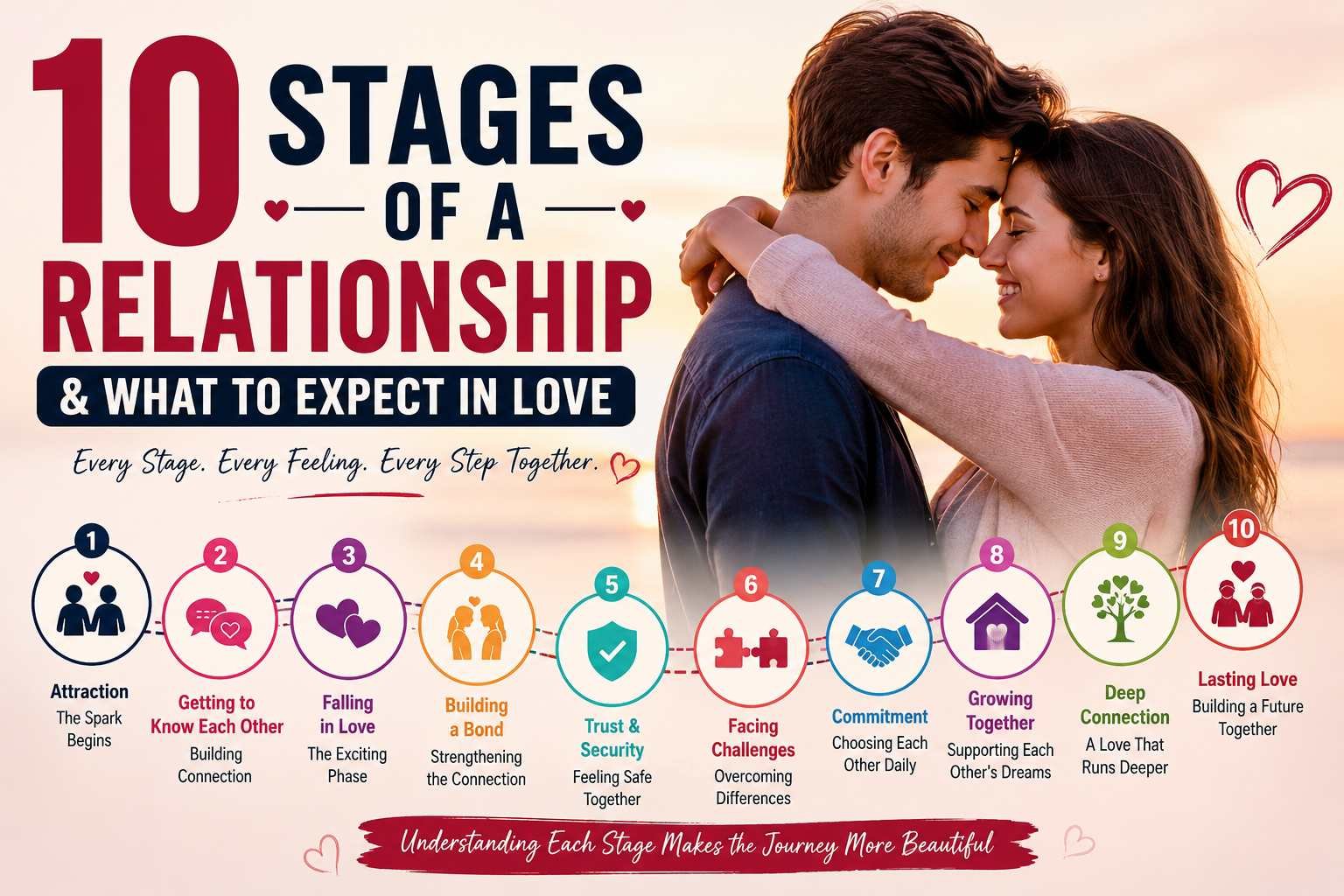
Understanding the stages of a relationship can help couples make sense of how love grows, changes, and sometimes becomes harder over time. Every relationship is different. Not every couple follows the same path. Many healthy relationships go through clear parts—from the excitement of a new connection to deeper emotional closeness, commitment, and long-term partnership.
Knowing what to expect can make changes in a relationship feel less confusing. The butterflies of a new romance may eventually turn into a calmer kind of love, while arguments can become chances to learn more about each other. Instead of seeing every change as a sign that something is wrong, it can be helpful to understand how relationships naturally change.
What Are the Stages of a Relationship?
The stages of a relationship describe the common parts couples may go through as they move from meeting and dating toward commitment and long-term partnership. These parts are not strict rules; some couples move quickly through them, while others spend years in one part.
Relationships can also move backward or revisit earlier parts. For example, a couple in a long-term relationship may find excitement again after going on a vacation, starting a new hobby, or working through a tough time together.
The important thing is not to compare your timeline with someone else. Instead, focus on whether your connection continues to provide respect, communication, emotional safety, affection, and mutual effort.
The 10 Stages of a Relationship
1. The Attraction and First Meeting Stage

The first part usually starts when two people notice each other and become interested in getting to know one another. Attraction can come from appearance, personality, shared interests, humor, values, or simply feeling comfortable around someone.
During this part, curiosity is often strong. You may find yourself thinking about the person a lot and looking forward to talks or dates. There is usually a desire to make a good impression—both people may show their best sides while slowly revealing more about themselves.
Signs of This Stage:
- Feeling happy when you get a message from the person
- Looking forward to seeing them
- Asking questions about their life and finding shared interests
- Feeling very curious about their personality
- Wanting to spend time together
- Experiencing physical or emotional attraction
This part can be exciting, but it is also important to stay realistic. Attraction is a start, not proof that two people are meant to be together long-term.
2. The Honeymoon Stage

The honeymoon period is one of the most exciting stages of a relationship. Couples often feel intense affection, talk constantly, feel strongly attracted, and want to spend all their time together.
Everything may seem good, and small actions feel important. Differences seem minor because both partners are focused on what they like about each other. During this time, the brain reacts strongly to attraction, which adds to feelings of excitement and attachment.
However, the honeymoon period does not last forever—and that is not necessarily bad.
Why the Honeymoon Stage Changes:
As couples get to know each other better, the excitement of newness naturally decreases. You start to see each other’s habits, weaknesses, stress reactions, and differences. Some people get worried when the constant excitement goes away and think, “Are we losing love?” Not always. Healthy relationships often move from excitement into a more stable and meaningful kind of connection.
3. The Getting to Know Each Other Stage

After the initial excitement, couples often start to learn who their partner really is. This is when conversations become more personal. You may talk about childhood memories, family relationships, career goals, money views, friendships, personal limits, and future plans.
You also begin to see how your partner acts outside of ideal moments:
- How do they act when they are stressed?
- How do they deal with disappointment?
- Are they kind to others?
- Can they say sorry when they make a mistake?
These observations are important because long-term compatibility is built on far more than chemistry.
Questions to Think About:
- What does commitment mean to you?
- What are your long-term goals?
- How do you handle disagreements?
- What role does family have in your life?
- How do you handle money?
- What are your expectations for communication and emotional support?
4. The Reality and Differences Stage

One of the most critical stages of a relationship happens when idealization starts to fade and reality becomes more visible. You may find habits that bother you, differences in how you talk, or disagreements about priorities.
This part can feel hard because the relationship no longer feels effortless. However, conflict does not automatically mean a relationship is unhealthy—arguments can teach couples how to navigate differences.
Healthy Conflict vs. Unhealthy Conflict
| Healthy Conflict | Unhealthy Conflict |
| Listening to each other | Insults and name-calling |
| Avoiding attacks and staying on topic | Threats or manipulation |
| Taking responsibility for mistakes | Constant criticism or deliberate embarrassment |
| Looking for good solutions together | Controlling behavior or ignoring limits |
The goal is not to have a relationship with zero disagreements. The goal is to learn how to handle differences in a healthy way.
5. The Adjustment and Compromise Stage

Once couples see their differences, they begin figuring out how to live with them. This does not mean giving up who you are or agreeing to everything your partner wants; healthy compromise means finding solutions that respect both people.
For example, if one person likes being around people while the other prefers quiet time, the couple can find a balance that works for both rather than one person always sacrificing. Compromise becomes especially important when couples make choices about work, living arrangements, money, family, and lifestyle.
What Healthy Compromise Looks Like:
- Both partners take turns adjusting their preferences.
- Both express their needs and see the other person’s point of view.
- Neither partner constantly gives up their friends, goals, privacy, limits, or values just to keep the peace.
6. The Deeper Emotional Intimacy Stage
As trust grows, couples feel comfortable showing vulnerability. Emotional intimacy means feeling safe enough to share thoughts, fears, worries, dreams, disappointments, and personal experiences without fearing judgment.
This part creates a stronger connection than early dating because you know your partner completely—strengths, weaknesses, hopes, and fears included.
Building Emotional Intimacy:
- Listening without trying to fix everything right away
- Asking thoughtful questions and remembering details
- Sharing your feelings honestly
- Keeping your word and showing gratitude
- Respecting vulnerability and offering support during tough times
7. The Commitment Stage
Commitment means deciding that you want to build a future together and working hard on the relationship. It does not always mean marriage; for some, it means being exclusive, moving in together, getting engaged, or making long-term financial and family plans.
What Commitment Needs:
- Mutual respect and reliability
- Honest communication and shared duties
- Emotional support and a willingness to solve problems together
- Respect for individual identities and a shared plan for the future
Commitment is not just promising to stay together when everything is easy—it also means deciding how you will act when life gets hard.
8. The Partnership Stage

Over time, couples start working as a true team. Instead of thinking strictly about “me” and “you,” they think more about “us” while still keeping their own identities.
This teamwork involves managing a home, supporting careers, taking care of children or pets, making financial decisions, or helping each other through life changes. At this point, love may not feel as dramatic as it did in the early days, but it feels significantly more steady.
The Value of Teamwork:
- Sharing housework fairly
- Supporting each other’s individual goals
- Discussing choices together
- Making time for affection and emotional check-ins
- Celebrating successes and solving everyday problems as a unit
9. The Challenges and Renewal Stage
Long-term relationships inevitably face problems: job changes, tight finances, growing families, health issues, or shifting personal goals. Some couples may feel emotionally distant during these times.
This does not mean the relationship is over. Sometimes couples simply need to make an intentional effort to reconnect and renew their bond.
How Couples Can Reconnect:
- Set up regular date nights without distractions
- Take a short trip or start a new activity together
- Have open conversations without interruptions
- Show gratitude often and look back at meaningful shared moments
10. The Long-Term Companion Stage
A relationship that has weathered time matures into a deep feeling of companionship. Partners know each other’s habits, personalities, pasts, strengths, and weaknesses inside and out.
The relationship feels safe, predictable, and deeply familiar. Being comfortable does not mean being bored—that familiarity brings profound emotional safety. Lasting love becomes less about constant excitement and more about trust, friendship, respect, and shared time.
Common Questions About the Stages of a Relationship
Do All Couples Go Through the Same Stages?
No. The stages of a relationship are better seen as general patterns rather than a strict schedule. Some couples build feelings slowly through friendship, while others move to commitment quickly. There is no set timeline. What matters is whether both people feel safe, respected, and happy with how the relationship is growing.
How Long Does Each Stage Last?
There is no set time for any part. The honeymoon phase might last a few months or longer, while the partnership phase can go on for years while changing with new situations. Age, maturity, life experience, communication skills, and personal goals all affect how fast a relationship evolves.
Which Stage Is the Hardest?
For most couples, navigating the stages of a relationship gets toughest during Stage 4 (Reality and Differences). This is when the initial dreamy view fades, and partners must learn to talk openly, compromise, and manage disagreements for the first time.
Can Couples Go Back to an Earlier Stage?
Yes. Relationships are fluid. A long-term couple in the companion stage might re-enter a renewed “honeymoon” phase during a vacation or after overcoming a major challenge together.
How to Keep a Relationship Strong at Every Step
Understanding the stages of a relationship can help couples avoid common mistakes as they grow together.
- Talk Often: Don’t wait until a problem is too big before speaking up.
- Show Appreciation: Frequently tell your partner what you value about them.
- Save Time for Each Other: Real connection requires presence—put away distractions and focus on each other.
- Allow Room to Grow: Remember that people change over time; take time to re-learn your partner as they evolve.
- Fix Things After Fights: Apologies, taking responsibility, and making real changes help couples recover after arguments.
When a Relationship Needs Professional Care
Not every hard time is a normal step. If a relationship involves control, constant lies, humiliation, emotional abuse, or physical harm, taking safety measures or getting individual help is critical. Couples counseling can be very helpful when both people want to improve communication and rebuild their connection, but it requires mutual effort.
Frequently Asked Questions About Relationship Growth
What are the main stages of a relationship?
Common parts include attraction, the honeymoon phase, getting to know each other, navigating differences, adjusting, deepening intimacy, making a commitment, building a partnership, facing challenges, and entering long-term companionship.
How many stages of a relationship are there?
There is no single number everyone agrees on. Different experts describe the process in different ways, but breaking it down into these ten main parts offers a clear way to understand how love evolves.
Conclusion
The stages of a relationship help explain how romantic connections change over time. From the excitement of initial attraction to deep companionship, each part brings different experiences, rewards, and challenges.
The main idea is that good relationships are not about following a strict timeline—they are about the quality of the connection, the willingness to talk honestly, and the ongoing effort both people put into supporting each other.
Love can become calmer without becoming weaker. In fact, as couples move through the stages of a relationship, they often find something even more valuable: trust, emotional safety, friendship, shared goals, and a lasting feeling of being a team.