

Searching for couples counseling near me can begin after another exhausting argument, a painful discovery, or months of feeling disconnected. Sometimes nothing dramatic has happened. You simply miss feeling understood by the person sitting beside you. Whatever brings you to this point, finding professional support starts with understanding your options and choosing someone equipped to address your concerns.
The search can feel overwhelming. Therapist profiles contain unfamiliar qualifications, different treatment approaches, and fees that are not always easy to compare. Meanwhile, you and your partner may have different expectations about what counseling should accomplish.
This guide explains how to evaluate local and online services, ask useful questions, prepare for an appointment, and recognize whether the support feels appropriate. You do not need a perfect explanation of your relationship before making an inquiry.

What Is Couples Counseling?
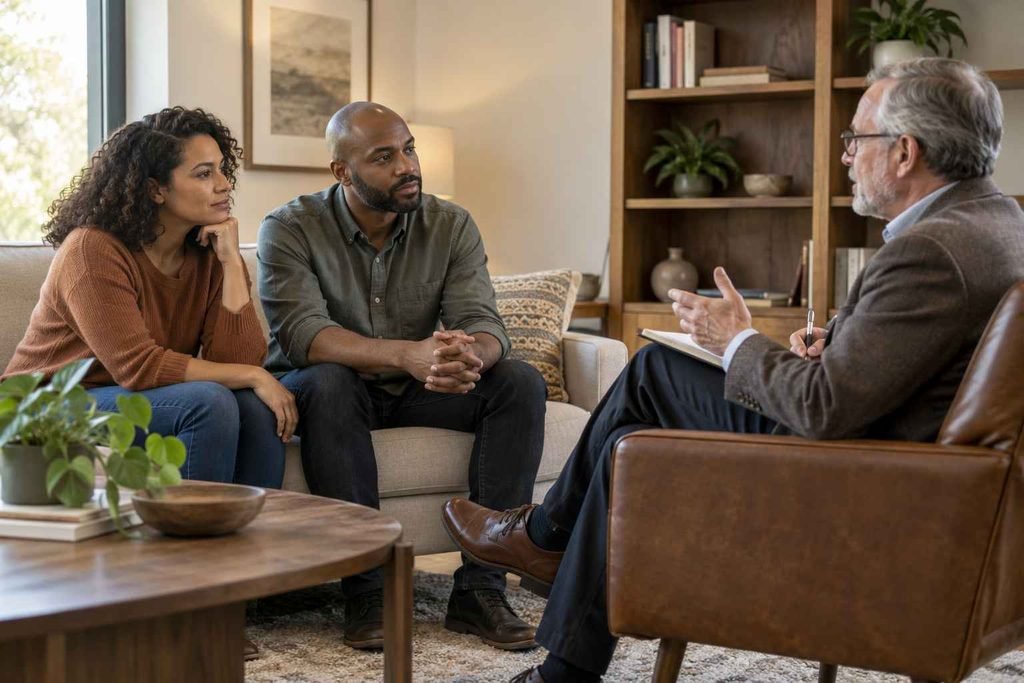
Couples counseling is a form of therapy that addresses concerns within a romantic relationship. Depending on the situation, sessions may explore communication, emotional distance, trust, intimacy, parenting, money, or decisions about the relationship’s future.
The therapist helps assess what is happening, establish appropriate goals, and guide conversations that may be difficult to manage alone.
For example, an argument about household chores might involve practical workload differences alongside feelings of being overlooked. Exploring both can produce a more useful conversation than repeatedly debating who washed the dishes.
Counseling does not require marriage. Dating partners, engaged couples, spouses, and long-term partners can seek relationship support. Ask whether the therapist has experience with your relationship structure and particular concerns.
When Might Professional Support Be Useful?
You do not have to wait until separation feels inevitable before considering therapy.
Reasons to explore support include:
- Repeating arguments without reaching a workable resolution.
- Feeling emotionally distant or persistently misunderstood.
- Struggling to discuss affection, sex, or boundaries.
- Disagreeing about parenting, finances, or family involvement.
- Adjusting to illness, caregiving, relocation, or parenthood.
- Deciding what to do after a breach of trust.
These experiences do not automatically mean the relationship is beyond repair. They suggest there may be issues worth examining with professional guidance.
You can also seek counseling when things are generally stable but an important transition is approaching. The purpose might be planning thoughtfully rather than managing an immediate crisis.
Begin Your Search With Clear Priorities
Before browsing couples counseling near me, identify what would make support both useful and accessible.
Write down the main concern in ordinary language. “We argue whenever money comes up” is a perfectly reasonable starting point. You do not need to diagnose yourself or your partner.
Next, consider practical requirements: appointment times, travel distance, budget, language, accessibility, and whether you prefer in-person or online sessions.
Professional directories can help you identify candidates. The American Association for Marriage and Family Therapy offers a therapist locator as one starting resource. A directory listing should still be followed by checking the professional’s current credentials and suitability.
Create a manageable shortlist rather than contacting dozens of providers. Three or four suitable options can make comparison easier.

Check Qualifications and Couples-Specific Experience
When comparing couples counseling near me, look beyond a welcoming photograph or reassuring introduction.
In the United States, relationship therapy may be provided by licensed marriage and family therapists, professional counselors, clinical social workers, or psychologists with appropriate training. Professional titles and regulatory requirements differ elsewhere.
Check the relevant licensing or registration authority for the provider’s profession and location. Confirm their current status and ask about any supervised practice arrangement.
Then ask about training specifically related to couples work. A professional who primarily treats individuals may have a different background from someone whose practice focuses on relationships.
Useful experience should relate to your needs, such as parenting conflict, infidelity, intercultural relationships, sexual concerns, or uncertainty about staying together.
A title alone cannot establish whether someone is the right fit.
Questions to Ask Before Booking
A brief consultation, when available, can help you evaluate couples counseling near me without committing to ongoing appointments immediately.
Ask questions such as:
- How much of your practice involves working with couples?
- Have you worked with concerns similar to ours?
- How do you assess whether joint sessions are appropriate?
- What approach do you use, and what would sessions involve?
- How do you respond when a conversation becomes heated?
- What are your fees, session lengths, and cancellation terms?
- How will we review progress?
You can also ask how the therapist works with partners who have different goals.
Pay attention to whether the answers are understandable. You should be able to ask for clarification without feeling embarrassed or pressured.
A consultation helps both sides decide whether proceeding makes sense.
Understand the Main Counseling Approaches

Therapists may use one established model or combine methods according to their training and assessment. Understanding the general focus can help you ask better questions.
Emotionally Focused Couple Therapy
Emotionally Focused Couple Therapy examines emotional responses and relationship patterns through an attachment-based framework. It may explore what happens when one partner seeks reassurance while the other becomes overwhelmed and withdraws. The aim includes changing distressing interaction patterns and strengthening emotional connection.
The Gottman Method
The Gottman Method begins with relationship assessment and uses interventions addressing areas such as conflict, friendship, and shared meaning. Ask how the therapist would adapt this framework to your situation.
Other Approaches
Some therapists emphasize behavioral changes, problem-solving, or acceptance of enduring differences.
The method’s name is only part of the decision. Ask what the work would look like in practice and why the therapist considers it appropriate.
Compare In-Person and Online Appointments
Your search for couples counseling near me may include therapists who offer video appointments as well as office visits.
In-person sessions provide a separate setting away from daily distractions. However, travel, childcare, and scheduling can make regular attendance difficult.
Online appointments can reduce those barriers, but you need a private space, suitable technology, and a setting where both partners can speak freely.
| Consideration | In-person appointments | Online appointments |
|---|---|---|
| Travel | Requires reaching the office | Usually avoids commuting |
| Privacy | Dedicated clinical setting | Depends on your surroundings |
| Access | Limited by practical travel distance | May broaden available options |
| Technology | Usually minimal requirements | Reliable connection and device needed |
| Scheduling | Includes travel time | Still requires protected appointment time |
For U.S. telehealth, confirm that the professional is legally permitted to work with each participant where they are physically located. HHS explains that behavioral health providers must meet applicable licensure requirements.

Discuss Costs Before Starting
When researching couples counseling near me, ask for the full fee rather than assuming every advertised appointment includes the same service.
Clarify the session length, whether the initial assessment costs more, and whether questionnaires or additional meetings involve separate charges.
Ask about cancellation deadlines and charges for missed appointments. These details matter when coordinating two schedules.
If you intend to use insurance, confirm the exact service and eligibility requirements with both the provider and your insurer. A therapist accepting your insurance does not establish that every type of appointment is covered.
If affordability is a concern, ask about sliding-scale places, supervised training clinics, or community services. Availability varies, so check current eligibility and waiting times directly.
Choose a plan you can realistically sustain.
What Happens During the First Session?
After choosing couples counseling near me, you may worry about explaining everything clearly or becoming emotional in front of someone unfamiliar.
The initial appointment often includes discussing your relationship history, current concerns, and what each partner hopes will change. The therapist may ask about previous treatment, relevant health issues, and personal safety.
Some assessment processes include questionnaires or separate conversations. Ask beforehand what the appointment will involve.
You do not have to describe every disagreement in chronological order. One recent example can help illustrate the problem.
Before leaving, aim to understand the proposed next step: further assessment, an initial treatment plan, a referral, or another recommendation.
The first meeting is an opportunity to assess fit, too.

Set Goals That Describe Everyday Change
“We want better communication” is understandable, but it can mean different things to each partner.
Try describing what you would notice if counseling were useful. Perhaps you want to discuss bills without shouting, make parenting decisions together, or understand why conversations repeatedly end in silence.
A practical goal might be:
“We want to agree on how to pause a difficult conversation and return to it.”
Another might be:
“We want both partners to understand and agree to the household responsibilities.”
Goals should be discussed collaboratively and reviewed as the work develops. They should also allow room for uncertainty.
You do not need to promise reconciliation before beginning an assessment.
Can Counseling Help After Infidelity?
Some people searching for couples counseling near me are coping with an affair, hidden messages, financial secrecy, or another serious breach of trust.
Start by asking whether the therapist has relevant training and experience. Also discuss whether ongoing deception, safety concerns, or conflicting intentions affect the suitability of joint work.
The process may involve clarifying boundaries, discussing accountability, and examining what each person needs before deciding whether to continue the relationship.
Forgiveness should not be treated as an immediate requirement, and a therapist cannot guarantee that trust will return.
Repair, when both partners choose it, involves behavior outside the consulting room as well as conversations within it.
Counseling may also help clarify that the partners want different futures.
What If One Partner Does Not Want to Attend?
Reluctance can have many explanations: cost, discomfort, previous experiences, fear of blame, or uncertainty about the relationship.
If it is safe to discuss, ask what concerns your partner has rather than assuming you know.
A specific invitation may help:
“I feel stuck with how we handle disagreements. Would you consider a consultation so we can understand the options?”
Avoid presenting therapy as punishment or a place where someone will prove your partner wrong.
You can seek individual support even if your partner declines. Your therapist can help you explore your choices, boundaries, and needs.
Individual counseling cannot make another person participate or change, but it can give you space to consider your own next steps.
Prepare Without Rehearsing a Case Against Your Partner
Before attending couples counseling near me, write a few notes to organize your thoughts.
Consider:
- What prompted you to seek help now?
- Which recurring situation feels hardest?
- What do you want the therapist to understand?
- What change would matter to you?
- What questions do you have about treatment?
Include things you value about the relationship if you can identify them. That provides context without minimizing problems.
Preparation does not require collecting evidence to win a disagreement. Focus on concrete events and their impact.
If something feels unsafe to disclose in front of your partner, contact the clinician privately to ask about a safe assessment process and confidentiality before sharing details.
Understand Confidentiality and Private Conversations
Couples work involves specific privacy questions because more than one person participates.
Before treatment, ask who is considered the client, how records are handled, and what happens if one partner contacts the therapist separately.
Ask whether the clinician has a policy about information shared in individual meetings. Do not assume that a private conversation will automatically remain undisclosed within the couple’s treatment.
Also ask about the limits of confidentiality and how relevant legal requirements apply.
AAMFT’s ethics guidance recognizes that relationship therapy raises distinctive confidentiality concerns when the client includes more than one person. Your provider should explain their own obligations and procedures clearly.
When Joint Counseling May Be Unsafe
Relationship conflict and abuse require different responses.
If there are threats, coercive control, physical or sexual violence, or fear of retaliation for speaking honestly, ordinary joint counseling may put the person experiencing abuse at further risk.
The National Domestic Violence Hotline advises against attending couples therapy with an abusive partner. Responsibility for abusive behavior belongs to the person using it; it should not be treated as a shared communication failure.
Seek confidential individual support from a professional or specialist domestic abuse service to discuss appropriate options. Use a safer device if your activity is monitored.
If there is immediate danger, contact local emergency services when safe.
Look for Progress Beyond the Appointment
Progress should relate to the goals you discussed.
You might notice clearer agreements, fewer repeated misunderstandings, greater willingness to acknowledge harm, or a better understanding of the decisions ahead.
A calm session alone does not show that everyday behavior has changed. Discuss what happens between appointments, including anything that becomes more difficult.
Ask for periodic reviews of the plan. What is improving? What remains stuck? Does the approach need adjusting?
If the therapist suggests exercises, explain any barriers honestly. An activity that feels manageable to one partner may feel confusing or unsafe to the other.
Safety concerns deserve prompt attention rather than waiting for a scheduled review.

Recognize When the Therapist Is Not a Good Fit
Therapy can involve uncomfortable conversations. However, discomfort does not mean you must accept humiliation, discriminatory comments, pressure, or unclear professional boundaries.
Raise concerns about the process if you feel able. A useful discussion might begin, “I do not understand how this exercise connects to our goals.”
Consider another provider if your concerns remain unaddressed or the therapist lacks suitable expertise.
Promises of guaranteed reconciliation or pressure to purchase a large package immediately deserve scrutiny.
You can ask about referrals and transferring care. Choosing a different professional is a reasonable decision when the current arrangement does not meet your needs.
Frequently Asked Questions
How do I choose couples counseling near me?
Start with credentials, relevant couples-specific training, and practical availability. Ask about the therapist’s approach, fees, safety assessment, and confidentiality policies. A consultation can help you decide whether to proceed.
Do we need to be married?
No. Many providers work with unmarried partners. Ask whether the therapist has experience with your relationship structure, life stage, and concerns before booking.
How many appointments will we need?
There is no reliable number for every couple. Assessment, goals, circumstances, and the recommended approach influence the plan. Ask when you will review progress and whether the schedule remains appropriate.
Will the therapist take sides?
The therapist should hear both perspectives while maintaining professional boundaries and addressing harmful behavior. Fair treatment does not require treating every action as equally responsible or acceptable.
Can we attend if we are considering separation?
Yes, some professionals help couples explore uncertainty about continuing their relationship. Explain your differing intentions early and ask whether the provider offers an appropriate service or referral.
What if we argue during a session?
Tell the therapist about escalation before treatment begins. Ask how they structure difficult conversations, when they interrupt, and how they assess whether joint meetings remain suitable and safe.
Does counseling guarantee we will stay together?
No. Outcomes vary. Appropriate support may help partners improve their relationship, understand their differences, or make clearer decisions about separating. No professional can promise a particular outcome.
Conclusion
Finding couples counseling near me involves more than choosing the closest office. Look for a qualified professional with relevant experience, clear policies, and an approach that makes sense for your concerns.
Begin with a manageable shortlist, ask direct questions, and choose arrangements you can realistically attend and afford. Explain your goals honestly, including uncertainty about what comes next.
You do not need to know all the answers before seeking support. A thoughtful assessment can help you understand your options, identify appropriate next steps, and decide what kind of help fits your situation.