
When you and your partner are deeply in love and you don’t want to lose your love and relationship, you have to maintain some communication habits.
Sometimes, strong relationships are not a joke; rather, they’re a serious issue between a couple. Also, some couples who love each other can slip into difficult arguments and awkward silence.
Moreover, if a partner feels stuck in a strong relationship, they may continue to cycle through the same fights over chores, money, and intimacy.
Furthermore, in this case, you and your partner are not alone. Therefore, this phenomenon shows that supportive relationships are essential to mental well‑being. However, some of us never learn evidence‑based skills to keep those bonds healthy.
In this blog, you can easily learn what the 4 horsemen of relationships are and learn about all the methods of couples therapy. Also, this guide will help Providence partners turn conflict into connection.
Here, you’ll also explore Gottman‑based premarital counseling sessions, and then you can easily start your marriage on a realistic basis.
The Foundations of the 4 Horsemen of relationships:
Over several years of research at the Love Lab Institute, professionals identified negative communication behaviors between partners that can lead to breaking up or divorce.
However, Gottman called these patterns the Four Horsemen theory. Also, they help couples understand how people communicate during disputes and how it affects a relationship over the long term.
Plus, this idea comes from watching a few couples and seeing how these negative ways of talking often lead to divorce or the end of a relationship.
Moreover, they are normal methods that slowly damage the foundation of a relationship. However, it is vital to recognize and deal with these common problems. In this way, people can build a safe and happy relationship.
Gottman Method of the 4 Horsemen of relationships:

Two popular researchers, Dr John and Julie Gottman, opened the famed “Love Lab” in 1986 to observe and study real love between couples. In that love lab, both researchers researched how real partners talk, laugh, and fight. Also, they tracked couples’ heart rates, facial expressions, and conversation style.
Therefore, both researchers have uncovered some patterns that predict whether a relationship will thrive or end in divorce. They also achieved over 80 percent accuracy in this study.
Disclosing the 4 horsemen of relationships:
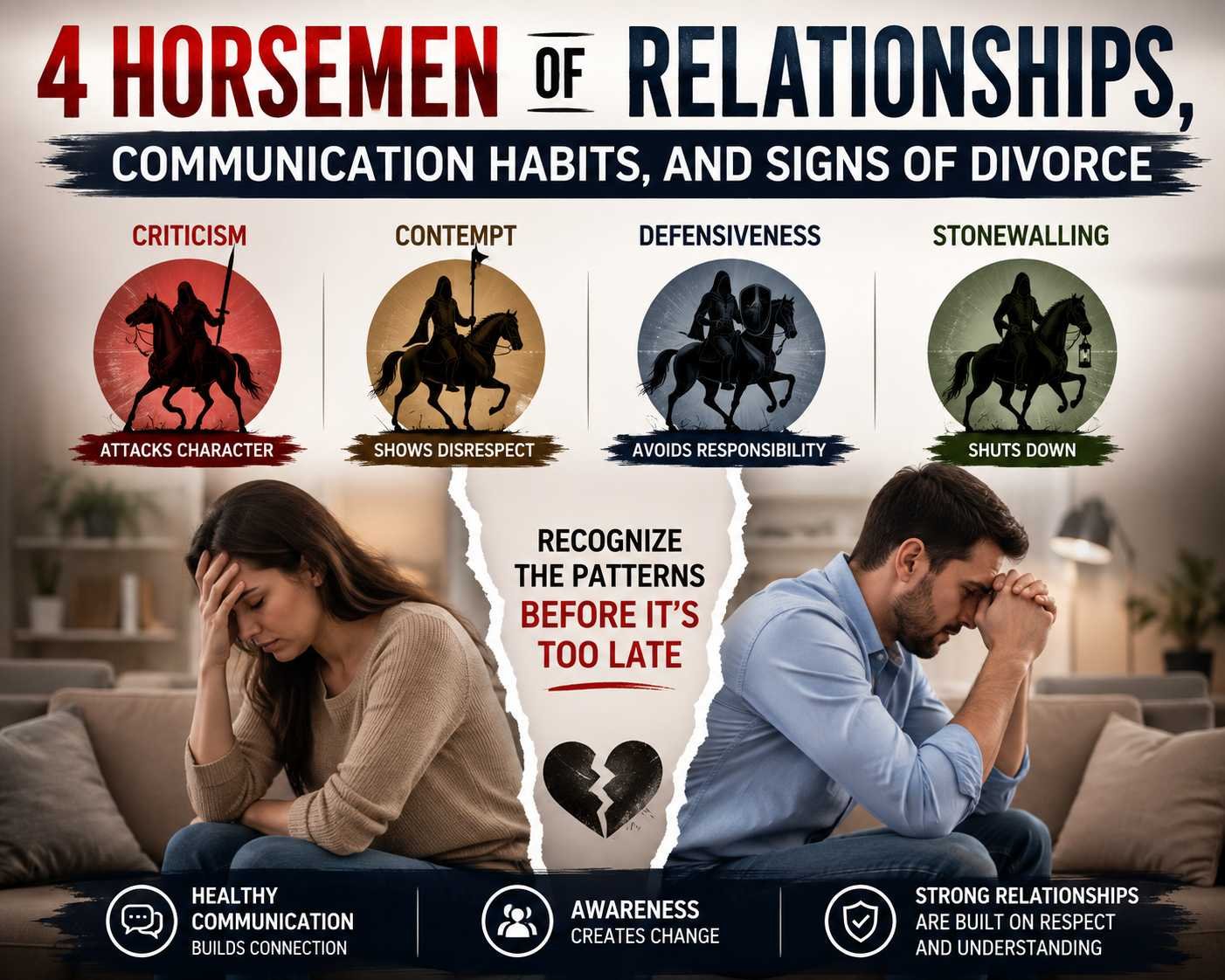
1: Criticism
2: Contempt
3: Defensiveness
4: Stonewalling
When you find these four symptoms in your relationship, you can replace them with healthy and loving gestures with your partner. Also, you can gain confidence and find solutions to the above hate-spotting symptoms. Moreover, a partner can lead the relationship with gentle start‑ups and mutual responsibility.
Gottman’s 4 Patterns:

The following are the 4 patterns mentioned here:
1: Criticism:
This criticism easily attacks a partner’s character rather than addressing a specific behavior.
2: Contempt:
When you and your partner communicate from a position of superiority through mockery, sarcasm, eye-rolling, and disgust.
3: Defensiveness:
You have the right to respond to a complaint with counter-complaints and excuses. Moreover, you can easily use righteous indignation instead of taking responsibility for something.
4: Stonewalling:
In this situation, you can easily withdraw from the partner’s interaction entirely and shut down. Also, you have the option to go silent or physically leave.
4 Horsemen research found that the above patterns tend to appear in predictable situations. Moreover, sometimes criticism opens the door to hate. When criticism becomes habitual in a relationship, then contempt follows as well.
Also, sometimes insults invite defensiveness in a relationship. And when defensiveness fails to resolve any fight between a couple, stonewalling takes over.
Furthermore, a loving relationship enters a loop where each partner’s worst response provokes the other’s worst response. In the end, the space for repairing a relationship can shrink with every cycle.
4 horsemen of relationships in a couples therapy journey:

In a relationship, a couple’s roadmap is unique to them and helps build a healthy relationship. Moreover, most couples follow four obvious steps to build a loving relationship.
Week 1: Assessment stage:
1: Mutual interview:
In this phase, a couple can easily share relationship goals like highs, lows, and hopes for the relationship’s therapy.
2: Single meetings:
A couple gets private space to voice concerns and problems.
3: Simple questionnaires:
Sometimes, tools like the Relationship Checkup provide objective insight into strengths and stress points.
Week 2: Feedback & Goal‑Setting time:
This is the second step in a relationship where a therapist pieces the information together and presents it as a simple treatment plan for you. Moreover, a partner will agree on 2–3 concrete goals, such as reducing contempt, rebuilding friendship, and navigating parenting stress.
Week 3–10: Skills‑Building Sessions
Professionals can easily facilitate gentle start‑ups and engaged listening for a couple. Moreover, they can easily build Love Maps with short data. Meanwhile, they assign a 20‑minute physiological break and suggest remedies such as soft tunes.
Week 4: Review & Monthly updates:
Once goals are set, sessions space out. The couple will refine new habits and create a written “rainy‑day plan” for future difficult days.
Premarital counseling session on the 4 Horsemen of relationships:

As we know, love is blind, and some of us are not ready for a serious relationship in real life. So, we should prepare for relationships and future goals.
Professionals have seven principles for making a marriage last and have translated some research findings into lessons for engaged or newly married partners.
1: Intended focus:
You can deal with potential flashpoints, such as money and faith, before they catch fire.
2: Strong review:
A couple celebrates what they already have in their relationship, such as fondness, common dreams, and humor.
3: Homework and sessions:
You can easily do some homework before short quizzes and date‑night questions before any date night.
4 Horsemen of Relationships: Tools & Exercises:
There are tools and exercises to help maintain a strong relationship.
1: Love Map apps:
You can map your love with quick prompts that deepen knowledge of a partner’s inner soul. Also, you can find the official deck or try the free app to test your love.
2: Stress‑Reducing talks:
You and your partner can arrange a 20‑minute night conversation with a check‑in that decreases tension and boosts oxytocin.
3: Debrief of a Fight Ritual:
A partner has structured out all the problems before it actually starts. Also, you can transform arguments into learning moments.
4: Dreams and Conflict conversion:
A professional helps couples honor each other’s primary values, which may be covered beneath surface fights.
5: Rotating small Bids:
A couple may notice and respond to every small gesture, such as a shared meme or a quick hug. Also, it keeps friendship alive.
Results a couple can expect:

1: A couple sitting on a sofa:
Some professionals show that partners may complete their relationship therapy. Moreover, they feel better, and they function better in their relationships.
2: Higher satisfaction:
A couple can gain satisfaction, and a review of several studies looking at the effectiveness of partner therapy in the easiest way.
3: Reducing dispute intensity:
Couples reported some blow‑up arguments or fights, with more calm problem‑solving moments.
4: Stronger friendship goals:
In this way, a couple can easily grow friendship goals by making some small gestures. Also, partners will always feel fresh when they decide not to worry or panic in every situation.
5: Protective health effects:
A happy relationship is linked to calm and peace; your partner has improved immune function by reducing fights and disagreements.
4 Horsemen of Relationship impacts on health:
In a relationship, when you find the presence of Gottman’s Four Horsemen patterns, it can really harm a healthy relationship. Moreover, these wrong ways of communicating can break trust, intimacy, and emotional connection between a couple.
Also, it creates a toxic space that frequently results in additional fights, bitterness, and even divorce.
When a couple does not tackle these common issues, it can start a downward spiral. In particular, some couples may become more critical, contemptuous, defensive, and then withdraw from their relationship.
This cycle can hurt both partners and the relationship itself. Also, it may lead to weaker relationship satisfaction, emotional pain, and poor mental health.
How to change your relationship via 4 horsemen of relationships?
As we all know, the Four Horsemen rules show negative ways of communicating, and they are an essential key to understanding that relationships may change.
With more knowledge, you may feel motivated to improve and find better ways to communicate. Also, couples can easily move from conflict to connection patterns. To build a healthy relationship, you may need to keep trying to understand each other’s problems and confront them together. Indeed, a couple’s therapist can help people find harmful patterns in their relationships. Eventually, a couple can learn new communication skills and strengthen their emotional bond.
Couple Therapy Methods for Overcoming the 4 Horsemen of relationships:

You can easily overcome the fear of losing a loyal partner. Also, a partner needs to replace bad communication behaviors with better communication steps. Moreover, it means that people should grow their emotional intelligence and compassion.
Furthermore, people also need to learn how to resolve all problems well. By using Gottman’s antidotes, some couples can turn harmful behaviors into chances for growth and connection.
Developing Emotional Intelligence in a relationship:
Emotional intelligence is very important for building healthy bonding in a couple. Sometimes, it may help couples to understand and manage their feelings.
Moreover, when a partner develops emotional intelligence, they can handle conflicts more effectively, communicate more effectively, and build stronger emotional bonds.
To advance emotional development, a partner should focus on self-awareness, practice empathy, learn to control emotions, and learn good communication skills.
Gottman’s Antidotes to the Four Horsemen rules:
Gottman rules for couples therapy provide strong tools for solving fights and their harmful effects. Also, these are antidotes for a relationship.
Moreover, these tools focus on changing negative communication into positive interactions. Furthermore, Gottman’s steps can help partners understand, empathize, and connect more effectively.
A couples therapist can help couples use these tools to improve their relationship. Couples therapy is also more effective than individual therapy for working through relationship disputes.
When partners use these tools regularly, they can change how they communicate with each other. Also, this change can lead to a stronger relationship founded on trust, respect, and love.
Most Frequently Asked Questions
1: What are important steps to resolve criticism in a relationship?
Ans: Resolving criticism means changing how a couple communicates. Also, it helps to use “I” statements to share their feelings. Moreover, couples should focus on specific actions rather than criticizing their partner’s character and ethics.
This clever approach boosts emotional connection by encouraging comprehension and compassion between a couple.
2: At what stage do relationships get hard for a couple?
Ans: Relationships are not a small thing; rather, they are a serious matter for everyone. Moreover, couples usually start to get difficult around 15 months to 2 years. As the couple gets involved with someone, feelings and emotions change.
3: What are the four factors in a relationship?
Ans: Four factors can cause a relationship to fail and lead to divorce. Also, the four signs of a failing relationship, the “Four Horsemen,” are criticism, contempt, defensiveness, and stonewalling.
4: How do a couple know it’s time to leave?
Ans: Well, a couple knows it is time to leave a job or relationship when it consistently costs more to their mental peace, health, and happiness than the positive value it provides.
5: What are essential signs a breakup or divorce is coming?
Ans: Some signs of a breakup or divorce include a sudden drop in communication, emotional distance, and a lack of interest in future goals. Moreover, some users believe that these changes do not happen suddenly but take time. Furthermore, couples do not pay attention to their relationship while they are looking for someone else.
6: What does a silent divorce mean?
Ans: A silent divorce is a slow emotional withdrawal where a couple checks out of a relationship without a formal conversation, big fight, or any official ending.
The Final Words:
4 Horsemen of Relationships are applicable in every couple’s lifestyle. One or both partners are bound to use one or more of the Four Horsemen factors at some point in their daily lifestyle. As a partner, get better at identifying these signs.
Moreover, a partner will be better equipped to repair the relationship at that moment when you learn to recognize these four factors and replace them with new skills. Also, you can reduce conflict, which becomes an opportunity to build honesty, vulnerability, and trust.
1 thought on “4 Horsemen of relationships: communication habits and signs of divorce”