

Looking for couples therapy near me often begins after a small moment that feels bigger than it should. Another conversation ends badly. You sit beside each other without knowing how to reconnect. One person says, “We cannot keep doing this,” and the other agrees but has no idea what would help.
Therapy offers a place to slow down and examine what happens between you. This guide explores how to choose support, set useful goals, and bring what you learn into everyday life. You do not need to be married, facing separation, or certain about the future to ask a qualified provider about your options.

What Couples Therapy Is Really For
Couples therapy focuses on the relationship and the experiences of the people in it. It can create space to explore communication, emotional closeness, disagreements, trust, and important decisions.
The work is more specific than having someone tell you to listen better. A therapist may help you notice a recurring interaction, understand what makes it difficult, and consider another response. Different clinicians use different approaches.
The American Association for Marriage and Family Therapy describes marriage and family therapists as professionals trained to address concerns within relationship and family contexts.[1] Other appropriately trained, licensed mental health professionals also work with couples.
The goal you bring matters. You might want to reconnect, navigate a transition, understand a breach of trust, or make a thoughtful decision about staying together. Discuss that goal rather than assuming the therapist will choose it for you.
You Can Seek Help Before a Relationship Crisis
There is no requirement to reach a breaking point before arranging an appointment. Sometimes partners seek help because things are mostly manageable and they want to address a pattern early.
Consider a couple who enjoy weekends together but argue every Sunday about the coming week. Each conversation begins with scheduling and ends with both feeling unappreciated. They may benefit from exploring responsibilities and expectations before resentment grows.
Searching for couples therapy near me can also be relevant during a move, pregnancy, career change, illness, or a shift in caregiving responsibilities. These transitions can expose differences that were easier to overlook before.
Ask yourself what keeps returning despite your efforts to resolve it. That recurring issue may be a useful starting point, even if you cannot explain the entire relationship in one sentence.

Notice the Pattern Beneath the Disagreement
The subject of an argument and the pattern of an argument are not always the same thing. One evening you disagree about money; another evening it is family visits. Yet the interaction feels familiar.
Perhaps one person asks repeated questions because uncertainty feels unsettling. The other hears criticism and gives shorter answers. Those short answers increase the first person’s worry, and both become more frustrated.
This is an illustrative pattern, not a diagnosis or a complete explanation. A clinician would need to understand the particular relationship, including whether either person feels unsafe.
When researching couples therapy near me, consider whether a provider explains how they explore these interactions. Useful work should allow discussion of context and accountability, rather than automatically assigning identical responsibility for every problem.
Start With One Honest Conversation About Help
Bringing up therapy can feel awkward. Choose a reasonably calm time and explain what you are hoping for in plain language.
You might say, “I feel lonely after our arguments, and I miss being able to talk comfortably. Would you consider meeting someone together?”
Keep the invitation connected to your experience. A statement such as “A professional needs to explain what is wrong with you” is more likely to be heard as an accusation.
If your partner hesitates, ask what feels difficult. They may worry about being judged, sharing private information, or committing to an expense they cannot sustain.
Starting your search for couples therapy near me does not require settling every concern immediately. Agreeing to look at a few providers or ask about an initial consultation can be a manageable first step. Attendance should not depend on pressure, threats, or a promise of a particular outcome.
Build a Shortlist That Fits Your Real Life
Consider your location, schedule, budget, accessibility needs, language preferences, and the concerns you want to address. Ask whether the clinician works with your relationship structure and respects your cultural or religious context.
A helpful shortlist for couples therapy near me combines these practical needs with relevant training. A beautiful office does not compensate for unsuitable expertise, and excellent credentials do not remove the need for appointment times you can attend.
Check professional licenses through the relevant licensing board. Then contact two or three providers to confirm the details their websites cannot answer.
Ask Questions That Reveal How the Therapist Works
Questions worth bringing include:
- What experience do you have with our main concern?
- What training have you completed in working with couples?
- How do you establish goals with partners who disagree?
- What usually happens during the assessment process?
- How do you respond when an appointment becomes tense?
- How do we discuss concerns about the therapy itself?
As you compare couples therapy near me, notice whether the provider makes room for these questions. A consultation should help establish suitability, not require you to accept sweeping promises.
It is reasonable for a clinician to say that an answer depends on assessment. That is different from avoiding basic information about qualifications, fees, consent, or the services offered.
Understand Different Approaches Without Getting Lost in Labels
Profiles may mention emotionally focused therapy, behavioral approaches, the Gottman Method, or an integrative style.
Ask for a practical example: “If we keep interrupting each other when we talk about parenting, what might you help us do during a session?”
The clinician might describe exploring emotions, slowing the conversation, practicing a skill, or assessing broader difficulties. Your task is to understand the proposed process, not select a method based only on a familiar name.
Ask about training in any approach advertised. Also ask how the therapist adapts when something is not helping.
A good explanation should acknowledge uncertainty. No therapy label can guarantee a specific outcome for every relationship or turn a complex situation into a predictable timetable.
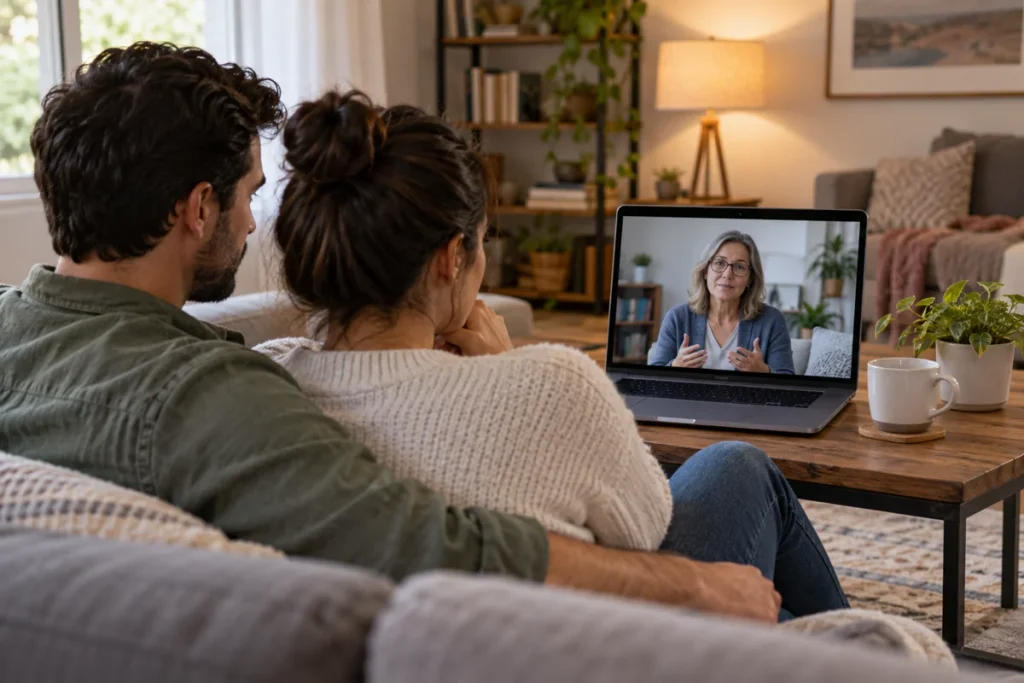
Decide Whether In-Person or Online Sessions Make Sense
Meeting in an office may provide a useful boundary between therapy and daily responsibilities. It can also offer privacy that is difficult to find at home.
Online appointments can reduce travel and make attendance more manageable. However, a private room, working technology, and freedom to speak without being overheard still matter.
Your search for couples therapy near me can include both formats. For virtual care, confirm the provider is legally permitted to work with you where you will physically be during appointments. U.S. telehealth requirements vary by state, and providers should verify patient location.[2]
If partners will join from different locations, ask about that arrangement in advance. Mention planned travel, too. Do not assume video appointments can continue automatically from another state or country.
Discuss Cost as Part of the Plan
A therapy plan needs to work financially as well as practically. Request clear information before booking, including the fee for an initial appointment and the length of subsequent sessions.
Ask about suggested frequency, cancellation charges, late arrivals, and whether any additional professional services carry separate fees. If a reduced fee is available, clarify the conditions.
When comparing couples therapy near me, verify insurance details with the provider and your insurer. Ask about the specific service, relevant benefit conditions, and your expected responsibility. A general mental health benefit does not establish that every relationship-focused appointment is covered.
If the fee is beyond your budget, ask about lower-cost referrals or supervised training clinics. Availability varies. An honest discussion about affordability can prevent interruptions and help you choose a realistic starting point.

Prepare for the First Appointment Together or Separately
Each partner can reflect on:
- What feels most difficult right now?
- What do I hope will change?
- What do I want the therapist to understand about me?
- What have we tried already?
- What still feels valuable in this relationship?
Try describing specific moments rather than relying on words such as “always” or “never.” “I felt dismissed when our plans changed without a conversation” is easier to explore than a broad judgment about someone’s character.
Bring questions about the process, and allow the clinician to guide how much detail to share initially.
Know What to Clarify About Privacy
Before discussing sensitive concerns, ask the therapist to explain confidentiality and its limits. Make sure you understand who the client is, how records are handled, and what policies apply to communication outside appointments.
Couples work can involve questions that do not arise in the same way during individual therapy. For example, what happens if one partner emails the therapist separately? Will individual assessment meetings be offered? How is information shared during those meetings handled?
Do not assume every practice follows the same policy. Read the consent documents and ask about anything unclear.
Also discuss practical privacy at home. Decide where appointment links, reminders, and notes will be kept. If privacy questions involve fear of a partner’s reaction, raise that concern confidentially with an appropriately qualified professional.
Make Goals Specific Enough to Use
“We want to feel closer” is meaningful, but it helps to explore what closeness would look like in ordinary life. Would you have more time together, feel less defensive, or discuss decisions more openly?
Translate a broad intention into a small behavior you can recognize. For example: “We want to make our weekend plans together before Friday afternoon.”
The value of couples therapy near me becomes clearer when you can connect sessions with agreed goals outside the office. Those goals should be realistic and developed with professional guidance.
Avoid turning them into a scorecard for catching mistakes. If a suggested activity increases distress or feels unsuitable, explain that rather than completing it simply because it was assigned.
Practice Between Sessions Without Turning Home Into a Clinic
Daily life provides opportunities to try a different response, but you do not need to analyze every conversation. Choose one small practice that you and your therapist consider appropriate.
For partners who feel safe together, a short check-in might involve sharing one difficult part of the week, one appreciated moment, and one practical need.
Make requests specific. “Could we spend ten minutes planning tomorrow?” is clearer than “You need to care more.” The listener can briefly reflect what they understood before responding.
These are general examples, not a treatment plan. They will not fit every relationship. If a conversation becomes overwhelming, discuss with your clinician how to pause and return to it constructively.
Activities should support the therapy goals rather than become another obligation that one person uses to criticize the other.

Review Progress Beyond Whether You Argued This Week
A disagreement-free week can be pleasant, but silence alone does not establish that things are improving. Sometimes partners stop arguing because they have stopped bringing up important concerns.
Consider whether you can discuss difficult subjects with more clarity. Are agreements more specific? Does each person have room to speak? Are apologies followed by different behavior?
Your clinician can help you review these questions in relation to your goals. Some periods may feel more difficult as avoided issues become clearer, but distress should not be dismissed automatically as proof that therapy is working.
Ask for a review when the purpose feels unclear or sessions repeatedly leave important concerns unaddressed. The plan may need adjustment, additional assessment, or a referral. You are allowed to ask how the current approach is helping.
When Joint Therapy May Be Unsafe
Fear changes what is possible in a shared conversation. Threats, coercive control, stalking, physical violence, and sexual violence require attention beyond ordinary communication advice.
The National Domestic Violence Hotline advises against couples counseling with an abusive partner because joint sessions can increase risk.[3] If speaking honestly could lead to punishment or retaliation, seek confidential individual support from a professional experienced in relationship abuse.
Communication difficulties do not cause another person’s abusive choices, and you are not responsible for preventing abuse by finding better words.
Do not begin relationship exercises that could make you less safe. Consider device privacy if someone monitors your activity. If you are in immediate danger, contact local emergency services when it is safe to do so.
Considering EmotionalTouches in Texas
EmotionalTouches provides educational relationship resources and reflection tools. These can help you identify a topic or prepare a question, but they are separate from professional therapy.
For readers seeking couples therapy near me in Kyle, Texas, the website currently describes in-person appointments in Kyle and online therapy for clients located in Texas.[4] Confirm availability, clinician credentials, fees, and suitability directly.
Visit EmotionalTouches and follow its current therapy or contact links. An initial message can ask about scheduling and next steps without including detailed health or relationship information. Save sensitive details for the appropriate intake process.
Frequently Asked Questions
Do we need to be married to attend?
Many providers work with unmarried, engaged, and long-term partners. Ask the clinician whether they work with your relationship structure and goals. Marriage is not automatically a requirement.
What if only one of us wants therapy?
Explain your hopes and invite your partner to discuss their concerns. If they decline, individual support may help you consider your own needs and choices. It cannot make someone else participate or change.
Will therapy guarantee that we stay together?
No. Outcomes depend on your circumstances and cannot be guaranteed. The work may support reconnection, clearer boundaries, decision-making, or a more thoughtful approach to separation.
Can we work with different therapists individually as well?
Discuss this with the professionals involved. Individual and couples work may address different needs. Ask about coordination, consent, confidentiality, and any concerns about overlapping roles.
How soon should we expect improvement?
There is no universal schedule. Ask for an initial plan and regular reviews rather than a guaranteed deadline. Useful early changes might include clearer goals or better understanding of a recurring interaction.
What if the therapist does not feel right?
Raise the concern if you can. Explain what feels missing and ask whether the approach can change. If the fit remains unsuitable, seeking another qualified provider is a reasonable choice.
Conclusion
A useful first step does not require certainty about every part of your relationship. It requires enough curiosity to ask what support might help and enough practical information to make an informed choice.
Approach your search for couples therapy near me with attention to qualifications, fit, privacy, affordability, and safety. Ask clear questions, identify one concern you want to understand, and choose a next step that is manageable. Your relationship does not need to look a certain way before your questions deserve thoughtful attention. undefined