
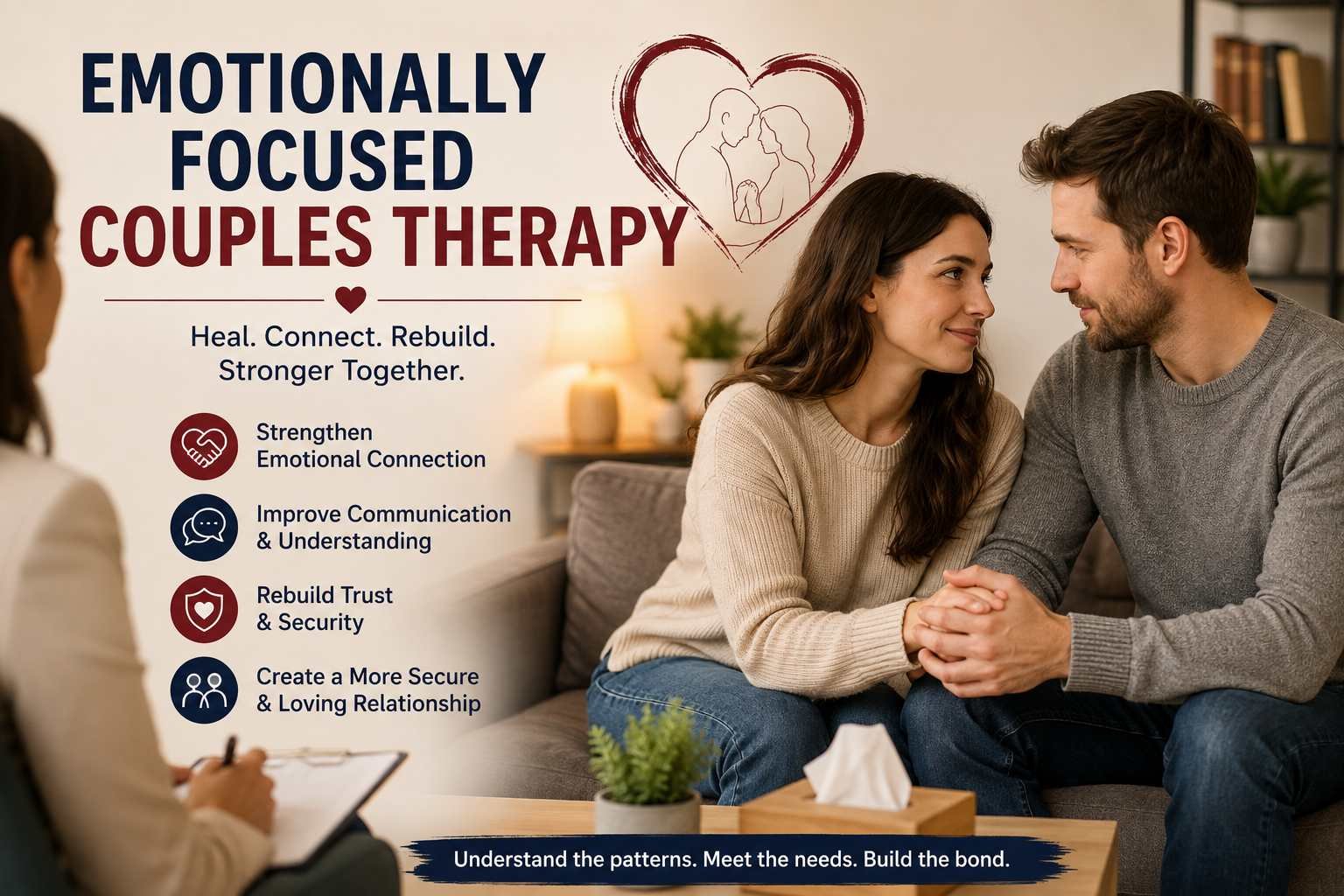
Emotionally Focused Couples Therapy is a structured approach to relationship counseling that helps partners understand the emotional patterns behind conflict, distance, insecurity, and disconnection. Rather than focusing only on arguments or individual behaviors, this approach explores the deeper emotional needs that influence how couples respond to one another. By identifying interaction cycles and creating safer emotional connections, couples can learn to communicate more openly, rebuild trust, and develop a stronger relationship.
Every relationship experiences challenges. Couples may argue about money, parenting, household responsibilities, intimacy, family issues, work stress, or differences in communication styles. However, many recurring conflicts are not really about the surface-level issue. Underneath the argument may be feelings of rejection, loneliness, fear, disappointment, or a desire for reassurance.
Understanding those emotions can change the way partners approach relationship problems.
What Is Emotionally Focused Couples Therapy?
Emotionally Focused Couples Therapy is a relationship counseling approach developed around attachment and emotional connection. It focuses on the bond between partners and examines the patterns that develop when one or both people feel disconnected or emotionally unsafe.
Instead of simply asking, “Who is right?”, the therapist helps couples explore questions such as:
- What happens emotionally when you feel rejected?
- Why does one partner pursue while the other withdraws?
- What fears are hidden underneath repeated arguments?
- What does each person need from the relationship?
- How can partners respond to one another with emotional security?
The goal is not to determine which partner is responsible for every problem. Instead, the process helps couples recognize interaction patterns and replace them with healthier ways of connecting.
This can be especially useful when couples feel stuck in the same arguments despite repeatedly trying to solve them.
How Does This Type of Couples Therapy Work?
Emotionally Focused Couples Therapy generally works by helping partners recognize their recurring emotional and behavioral cycles.
For example, imagine one partner frequently asks for attention and reassurance. The other partner feels overwhelmed and responds by becoming quiet or emotionally distant. The first partner then becomes more anxious and pushes harder for reassurance. The second partner withdraws further.
Eventually, both people feel misunderstood.
The problem may appear to be poor communication from one person and emotional withdrawal from the other. Underneath the cycle, one partner may be afraid of being abandoned, while the other may fear failure, rejection, or constant criticism.
Therapy helps the couple see that the real opponent is the cycle—not each other.
Understanding the Negative Relationship Cycle

One of the central ideas in Emotionally Focused Couples Therapy is that couples can become trapped in repetitive interaction cycles.
These cycles can take several forms:
The Pursue-and-Withdraw Cycle
One partner repeatedly seeks discussion, reassurance, affection, or answers. The other partner feels overwhelmed and pulls away. The more one pursues, the more the other withdraws.
The Criticize-and-Defend Cycle
One person raises concerns through criticism, while the other responds defensively. Instead of solving the original problem, both partners become focused on protecting themselves.
The Attack-and-Attack Cycle
Both partners respond to frustration with anger, blame, accusations, or harsh words. Each person believes they must defend themselves, making emotional closeness increasingly difficult.
The Withdraw-and-Withdraw Cycle
Sometimes, neither partner wants to address emotions. Both become distant, avoid conversations, and gradually stop sharing their inner experiences.
Recognizing these cycles can be powerful because it shifts the focus from blaming a person to understanding the pattern.
Why Emotional Connection Matters in Relationships
Many couples believe that effective communication means learning how to debate disagreements calmly. While communication skills are certainly valuable, emotional connection influences how partners interpret everything the other person says and does.
When people feel emotionally secure, they are often more willing to listen, compromise, apologize, express vulnerability, and discuss difficult subjects.
When they feel emotionally threatened, even a small disagreement can feel much larger. A simple question may sound like criticism. A request for space may feel like rejection. A delayed text message may trigger insecurity. A partner’s silence may be interpreted as anger or a lack of love.
Strong emotional connection does not mean couples will never disagree. Instead, it provides a foundation that makes disagreements easier to manage.
What Happens During Therapy Sessions?

A typical therapy process involves conversations about the relationship, recurring conflicts, emotional reactions, and each partner’s experiences.
The therapist encourages both partners to slow down and identify what they are actually feeling.
For example, instead of saying:
“You never care about me.”
A partner might learn to communicate:
“When you become quiet during an argument, I start feeling alone and worry that I don’t matter to you.”
The second statement communicates vulnerability rather than blame. The other partner then has an opportunity to respond to the underlying emotion rather than defending against an accusation.
Over time, couples practice expressing needs in ways that make emotional connection easier.
Who Can Benefit From This Approach?
Emotionally Focused Couples Therapy can be helpful for couples experiencing a wide range of relationship difficulties.
It can be considered when partners are dealing with:
- Frequent arguments
- Emotional distance
- Communication problems
- Trust difficulties
- Feelings of loneliness
- Repeated misunderstandings
- Relationship insecurity
- Difficulty expressing emotions
- Intimacy concerns
- Major relationship transitions
- Ongoing resentment
- Fear of abandonment
- Repeated conflict cycles
It is also useful for couples who technically communicate often but still feel emotionally disconnected. Talking more does not necessarily mean connecting more. Sometimes couples need to understand what their conversations are really communicating on an emotional level.
Can Therapy Help Couples Rebuild Trust?

Trust can become damaged for many reasons: infidelity, dishonesty, broken promises, emotional disconnection, and repeated disappointments can all affect a relationship.
Rebuilding trust usually requires more than saying “I’m sorry.”
The hurt partner may need consistency, reassurance, transparency, and evidence that the relationship is becoming safer. The partner who caused the hurt needs to understand the impact of their actions without becoming defensive.
A therapist helps couples discuss these difficult subjects in a structured, safe environment. The process does not erase past experiences; instead, it helps partners understand what happened, communicate their needs, and determine whether they can build a healthier pattern moving forward.
The Role of Attachment in Romantic Relationships
Attachment is another core concept in Emotionally Focused Couples Therapy.
People often develop expectations about relationships based on past experiences. These expectations influence how they respond when they feel threatened or disconnected.
One person might become highly anxious when a partner needs space. Another might become uncomfortable when conversations become emotionally intense. Neither response automatically means someone does not care. In many cases, these behaviors are attempts to protect oneself from emotional pain.
Understanding this helps partners become more compassionate toward one another. Instead of thinking, “My partner is intentionally ignoring me,” someone might begin to recognize, “My partner is overwhelmed and trying to protect themselves.”
That shift in perspective creates room for a healthier conversation.
How It Differs From Traditional Couples Counseling
Traditional couples counseling uses different strategies depending on the therapist, relationship concerns, and the needs of the couple.
Some approaches focus heavily on communication skills, problem-solving, negotiation, or changing individual behaviors. Emotionally Focused Couples Therapy places greater emphasis on emotional attachment, vulnerability, and underlying relationship patterns.
This does not mean practical communication skills are unimportant. Rather, communication techniques become more effective when partners understand the emotions underneath their behavior. Learning to use “I” statements is helpful, but a couple makes even greater progress when each partner understands the fear or longing behind a repeated complaint.
What Are the Main Goals?

While goals vary depending on the couple, several themes are common:
- Creating Emotional Safety: Partners learn to become more responsive to each other’s needs.
- Breaking Negative Cycles: Couples identify toxic patterns and learn alternative ways to respond.
- Increasing Vulnerability: Partners become more comfortable expressing fears, needs, disappointments, and desires.
- Strengthening Attachment: The relationship becomes a secure source of emotional support.
- Improving Communication: Couples learn to discuss difficult topics without automatically falling into blame, defensiveness, or withdrawal.
- Building Lasting Connection: The ultimate goal is not simply ending arguments—it is building an emotional bond that helps partners handle inevitable challenges together.
How Long Does Couples Therapy Take?
There is no fixed timeline for relationship counseling.
Some couples notice changes quickly, while others need more time because their conflicts are deeply established or involve significant emotional injuries.
Progress depends on several factors:
- How long the problems have existed
- Whether both partners participate actively
- The severity of relationship distress
- Willingness to be emotionally vulnerable
- Ability to practice new responses outside of sessions
- Whether major external stressors are present
- The experience and approach of the therapist
Consistency is generally more useful than expecting a transformation after one or two sessions.
How to Find the Right Couples Therapist
Choosing the right therapist is an important decision.
Start by researching professionals who specifically work with couples and have formal training in the approach you are considering.
You can ask potential therapists questions such as:
- What is your experience working with couples?
- What relationship issues do you commonly treat?
- How do you structure couples sessions?
- What can we expect during the first few appointments?
- How do you handle situations where partners disagree strongly?
- What approach do you use with couples experiencing deep disconnection?
It is vital that both partners feel reasonably comfortable with the therapist. A good therapeutic relationship makes it easier for couples to discuss sensitive subjects honestly.
What Couples Can Do Between Sessions

Progress does not have to happen solely inside the therapy room. Couples can practice healthy relationship habits between sessions:
- Make Time for Meaningful Conversations: Set aside time to talk without phones, television, or other distractions.
- Listen Before Responding: When your partner shares something, try to understand their perspective before immediately explaining your own.
- Notice Your Cycle: When conflict begins, ask yourself what pattern is developing. Are you pursuing? Withdrawing? Defending? Criticizing?
- Express Needs Clearly: Instead of expecting your partner to guess what you need, communicate your needs directly and respectfully.
- Practice Appreciation: Regularly acknowledge things your partner does well. Positive interactions help balance the relationship during stressful periods.
- Slow Down During Conflict: If emotions become overwhelming, taking a temporary break can be useful. The important part is returning to the conversation rather than using distance as permanent avoidance.
Common Misconceptions About Couples Therapy
- “Therapy is only for couples on the brink of divorce.” This is untrue. Couples can seek support at any stage of a relationship to strengthen their bond before crisis hits.
- “Therapy is about deciding who is right.” In relationship-focused approaches, the purpose is not to declare a winner or assign guilt.
- “Therapy guarantees a saved relationship.” Therapy cannot guarantee an outcome. However, it provides a safe environment for understanding relationship patterns and making informed decisions.
Is It Only for Married Couples?
No. Relationship counseling is relevant for dating couples, engaged couples, long-term partners, and any committed relationship. The primary factor is the relationship itself and the shared desire to address underlying concerns.
Couples do not need to wait until a problem becomes severe; seeking help early often prevents negative patterns from becoming deeply entrenched.
What If One Partner Wants Therapy and the Other Doesn’t?
Ideally, both partners participate because the relationship involves two people. However, one partner can still learn communication and emotional-awareness skills independently.
If your partner is reluctant, avoid using therapy as a threat or presenting it as proof that something is wrong with them. A calmer approach is to explain what you hope to improve and why professional support could benefit both of you.
Ultimately, each person must decide whether they are willing to participate.
Frequently Asked Questions
What is Emotionally Focused Couples Therapy?
It is a relationship-focused approach that examines emotional attachment, recurring interaction patterns, vulnerability, and the emotional needs that influence how partners respond to each other.
Is Emotionally Focused Couples Therapy effective?
Research strongly supports emotionally focused approaches to couples therapy, though individual outcomes vary. Factors such as commitment to the process, therapist expertise, and active participation heavily influence progress.
How is it different from regular couples counseling?
This approach places greater emphasis on emotional bonds and negative interaction cycles rather than solely teaching conflict-resolution mechanics or behavioral tricks.
Can this therapy help couples who argue constantly?
Yes. It helps couples understand why arguments repeatedly happen and identifies the underlying cycle that keeps them stuck, allowing them to de-escalate conflicts faster.
Can couples use therapy to rebuild intimacy?
Yes. A major focus is helping partners communicate feelings and respond to one another in supportive ways, creating the emotional safety required for true physical and emotional intimacy.
Should couples wait until their relationship is in trouble?
Not at all. Couples can seek support whenever they notice communication problems, emotional distance, or recurring conflicts they cannot resolve on their own.
Does couples therapy guarantee that a relationship will survive?
No. Therapy cannot guarantee that partners will remain together, but it helps both individuals understand their dynamic, improve interaction patterns, and make informed decisions about their future.
Conclusion
Healthy relationships are not defined by the absence of conflict. Every couple experiences disagreements, misunderstandings, stress, and moments of disconnection. What matters is how partners respond when those challenges occur.
Emotionally Focused Couples Therapy offers a way to look beneath repeated arguments and understand the emotional patterns that keep partners stuck. By identifying negative cycles, expressing vulnerable feelings, strengthening emotional responsiveness, and creating greater security, couples can work toward a deeper, more connected relationship.
The process requires patience and participation from both partners. Real change develops through repeated experiences of listening, understanding, responding, and repairing. If your relationship feels trapped in the same cycle again and again, professional support can provide the structured opportunity you need to heal and reconnect.