
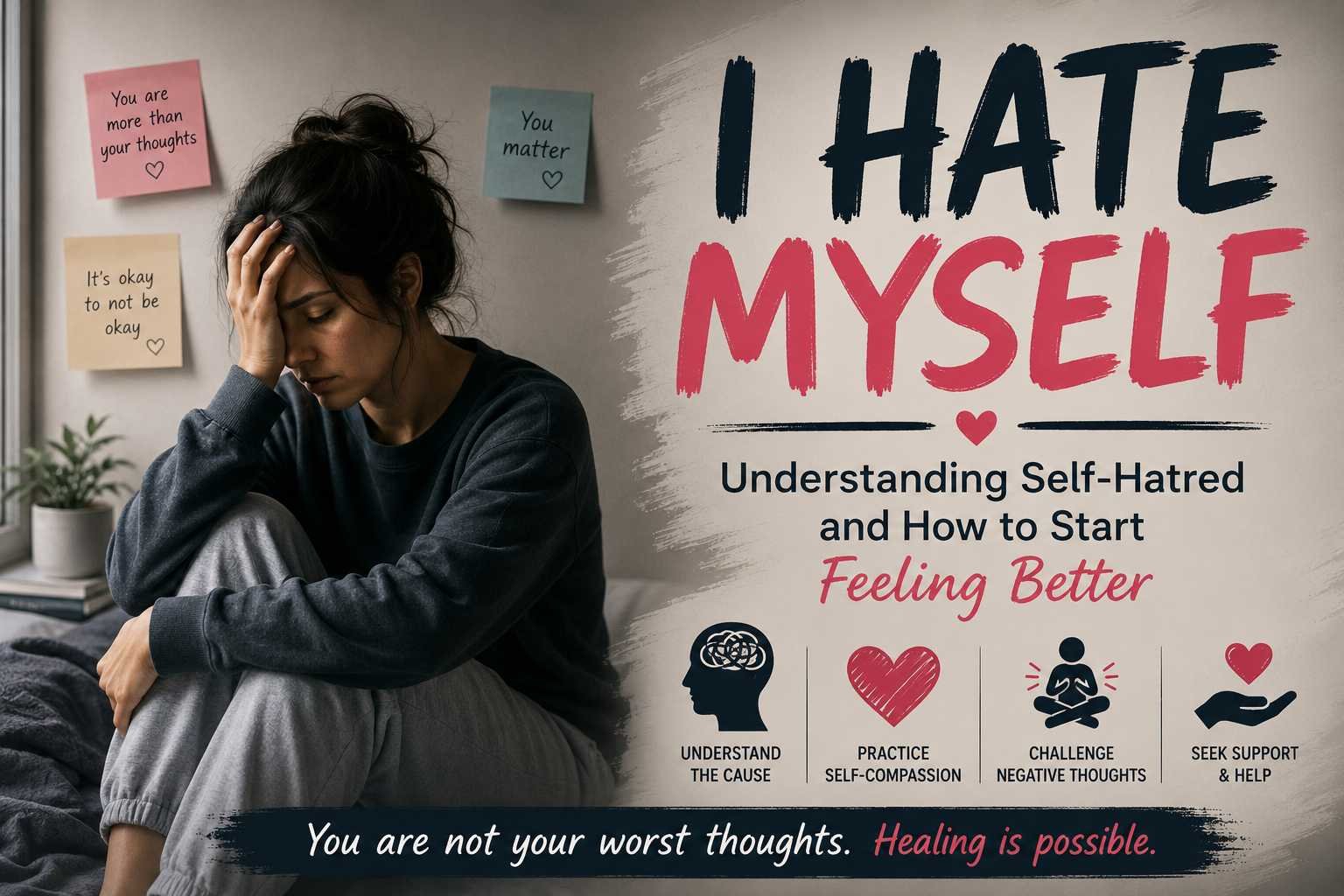
“I hate myself” is a thought that many people experience during periods of intense stress, disappointment, loneliness, guilt, or low self-esteem. Sometimes it appears after making a mistake or experiencing rejection. At other times, it can become a repeated belief that affects relationships, work, confidence, and everyday life. Although self-hatred can feel overwhelming, having these thoughts does not mean that you are worthless or incapable of change. Understanding where these feelings come from and learning ways to respond can be an important first step toward feeling better.
What Does “I Hate Myself” Really Mean?
When someone thinks “I hate myself,” the statement may represent more than simple dislike. It can reflect disappointment, shame, guilt, insecurity, sadness, or frustration with a particular part of life.
For example, someone might dislike their appearance, regret something they said, feel unsuccessful at work, or believe they have disappointed someone they care about. Instead of separating the problem from their identity, they may turn the criticism inward.
There is a difference between saying:
- “I made a mistake.”
- “I don’t like how I handled that situation.”
- “I want to improve this part of myself.”
And saying:
- “I’m a terrible person.”
- “I ruin everything.”
- “I don’t deserve good things.”
The first group focuses on behaviors or circumstances. The second group turns an experience into a judgment about a person’s entire identity.
Learning to recognize this difference can help you challenge self-judgments.
Why Do People Feel “I Hate Myself”?
There is rarely one single explanation for self-criticism. These feelings can develop from a combination of experiences, beliefs, circumstances, and emotional patterns.
1. Past Criticism

Repeated criticism from parents, teachers, peers, partners, coworkers, or other people can influence the way someone eventually talks to themselves.
If a person repeatedly hears that they are not smart enough, attractive enough, successful enough, or good enough, they may eventually internalize those messages.
The external critic can become an internal voice.
This doesn’t mean that everything someone was told about themselves was true. It means that repeated messages can influence self-perception.
2. Perfectionism
Perfectionism can create unrealistic standards.
A perfectionistic person may believe that mistakes are unacceptable and that anything less than excellent is a failure. Even genuine accomplishments may feel insignificant because attention immediately shifts toward what could have been better.
A small mistake can therefore become evidence of total failure.
Over time, this pattern can contribute to thoughts such as “I hate myself” because the individual evaluates their worth according to impossible standards.
3. Comparing Yourself With Others

Comparison has always existed, but social media can make it particularly difficult to escape.
You may see someone’s career, relationship, appearance, home, vacation, fitness progress, or financial success and compare it with your own life.
The problem is that you’re usually comparing your reality with a carefully selected part of someone else’s.
A person may post their achievements without showing their anxiety, struggles, family problems, loneliness, or private disappointments.
Constant comparison can make ordinary imperfections seem like failures.
4. Relationship Problems

Rejection, betrayal, conflict, or the end of a relationship can seriously affect self-esteem.
Someone who has been rejected may think:
“What’s wrong with me?”
“Why wasn’t I enough?”
“Maybe nobody will ever love me.”
These questions can gradually become self-attacks.
A relationship ending does not establish your value as a person. Compatibility, timing, circumstances, communication, and many other factors can influence relationships.
5. Guilt and Shame

However, Guilt and shame are different emotional experiences.
Guilt often focuses on behavior:
“I did something bad.”
Shame can become more global:
“There is something wrong with me.”
Healthy guilt can sometimes motivate someone to apologize, repair harm, or make a better decision in the future. Shame, however, can encourage hiding, isolation, and relentless self-punishment.
Understanding the difference can make it easier to respond to mistakes.
Signs That Self-Hatred May Be Affecting Your Life
Self-critical thoughts can appear occasionally without controlling someone’s life. However, persistent self-hatred may show up in several ways.
You might notice:
- persistent negative thoughts about yourself
- difficulty accepting compliments
- constantly comparing yourself with others
- feeling undeserving of happiness
- withdrawing from friends or family
- believing that mistakes define you
- excessive guilt over ordinary situations
- difficulty recognizing personal achievements
- avoiding opportunities because you expect failure
- constantly criticizing your appearance
- feeling uncomfortable when receiving kindness
- or believing that other people would be better off without you.
If these experiences are persistent or interfering with life, talking with a mental-health professional can be worthwhile.
The Difference Between Self-Improvement and Self-Hatred

Wanting to improve yourself is not inherently negative.
You may want to become healthier, communicate better, manage your time, develop a skill, or change a habit.
Healthy self-improvement sounds like:
“I made a mistake, but I can learn from it.”
Self-hatred sounds like:
“I made a mistake, so I’m a failure.”
The first approach leaves room for growth. The second treats the situation as a permanent verdict.
You can hold yourself accountable without attacking your identity.
Instead of asking, “What’s wrong with me?”, try asking:
“What happened, and what can I do differently next time?”
That small change in wording can create a more constructive mindset.
How to Stop Being Hard on Yourself

Changing deeply established self-critical thinking takes time. The goal isn’t to force yourself to love everything about yourself right away.
A realistic goal is learning to treat yourself with fairness and compassion.
1. Notice Your Inner Voice
Pay attention to what you say to yourself after something goes wrong.
Would you say the same thing to a close friend who made the same mistake?
If you would comfort your friend but attack yourself, that difference is worth examining.
Write down recurring self-critical statements and look for patterns.
You may discover that your internal language is much harsher than the language you use with everyone else.
2. Separate Facts From Judgments
Suppose you make a mistake at work.
The fact might be:
“I missed a deadline.”
The judgment might be:
“I’m completely useless.”
The fact can be addressed. You can identify why the deadline was missed and develop a better system.
The judgment is a harsh conclusion about your worth that may not be supported by the evidence.
Practicing this distinction can help reduce self-criticism.
3. Challenge All-or-Nothing Thinking
Self-hatred often involves extreme language:
- always
- never
- everyone
- nobody
- completely
- worthless
- failure
These words can make problems seem permanent.
Instead of thinking “I always ruin everything,” try:
“I handled this situation poorly, but that doesn’t describe everything I have ever done.”
Balanced thinking doesn’t mean pretending that mistakes don’t matter. It means keeping them in proportion.
4. Stop Using Mistakes as Your Identity
You can make a poor decision without being a bad person.
You can fail an exam without being unintelligent.
Also, You can lose a job without being worthless.
You can experience rejection without being unlovable.
You can regret something without being defined by it.
A person’s behavior can change. Circumstances can change. Skills can improve. Relationships can end. Life is not a permanent judgment.
5. Practice Self-Compassion
Self-compassion doesn’t mean making excuses.
It means responding to yourself with the basic kindness you might offer someone else who is struggling.
Try saying:
“This is difficult right now.”
“I don’t have to solve everything today.”
“I made a mistake, but I can learn from it.”
“I am allowed to be imperfect.”
These statements may initially feel unnatural if you’ve spent years criticizing yourself. That’s okay. New patterns often take repetition.
What to Do When “I Hate Myself” Thoughts Appear

When a painful thought appears, you don’t necessarily have to argue with it for hours.
Try creating some distance from the thought.
Instead of:
“I hate myself.”
Try:
“I’m having the thought that I hate myself right now.”
This small change can remind you that a thought is an experience occurring in your mind—not an accurate measurement of your value.
You can then ask:
- What triggered this thought?
- Am I overwhelmed?
- Did something specific happen?
- Am I judging myself more harshly than I would judge another person?
- What evidence supports this belief?
- What evidence contradicts it?
- What would I tell someone I care about in this situation?
The goal is not to pretend everything is perfect. It is to respond to yourself fairly.
Take Care of Your Basic Needs

Negative thinking can become worse when you’re physically and emotionally exhausted.
Try paying attention to basic needs such as:
- getting enough sleep
- eating regularly
- drinking enough water
- moving your body
- spending time outdoors
- taking breaks from social media
- staying in touch with people who support you
- and creating some structure in your day.
These steps aren’t a complete solution for serious emotional difficulties, but they can support overall well-being.
Even a short walk or a shower can sometimes create enough distance from an overwhelming thought to make the next step easier.
Talk to Someone You Trust

Self-hatred often becomes stronger when it stays completely private.
You don’t have to explain everything. You can simply tell someone:
“I’ve been feeling really badly about myself lately, and I don’t want to deal with it alone.”
A trusted friend, family member, mentor, counselor, or healthcare professional may provide support.
You don’t need to wait until your situation becomes a crisis before asking for help.
Professional Support Can Help

If thoughts of self-hatred are constant, strong, or interfering with your life, consider talking to a mental-health professional.
Therapy can help you explore the experiences behind your self-criticism and develop healthier ways of thinking and responding.
Approaches such as cognitive behavioral therapy (CBT) may help people identify unhelpful thought patterns and replace them with more balanced perspectives. Depending on the circumstances, a professional may also consider other therapeutic approaches.
If your feelings are connected to depression, anxiety, trauma, or another mental-health concern, getting an appropriate assessment can help identify what kind of support may be useful.
Seeking therapy doesn’t mean you’re weak. It means you’re taking your well-being seriously.
What If You Don’t Believe Positive Things About Yourself?
Some people struggle with positive affirmations because statements such as “I am amazing” feel completely unbelievable.
You don’t have to start there.
Instead, use neutral statements.
For example:
Instead of:
“I love everything about myself.”
Try:
“I am learning to understand myself.”
Instead of:
“I never make mistakes.”
Try:
“I can make mistakes and still have value.”
Instead of:
“Everything about me is perfect.”
Try:
“I don’t have to be perfect to deserve respect.”
Neutral statements can feel more believable and may provide a practical bridge between harsh self-criticism and genuine self-acceptance.
How to Rebuild Your Self-Worth
Self-worth doesn’t have to depend on achievement, appearance, popularity, money, or relationship status.
Consider building a broader sense of identity.
You are more than:
- your job,
- your grades,
- your relationship,
- your body,
- your mistakes,
- your income,
- your social media presence,
- or other people’s opinions.
Make a list of qualities and roles that matter to you.
Maybe you’re a good friend. Maybe you care deeply about your family. You’re curious, creative, hardworking, patient, humorous, thoughtful, or willing to learn.
Your value isn’t limited to the areas where you currently feel successful.
When Self-Hatred Is Connected to Appearance
Negative feelings about appearance can become especially intense.
You may focus on your weight, skin, hair, height, facial features, clothing, or another aspect of your body.
Remember that appearance standards change across cultures, generations, and social environments. Images online may also be edited, filtered, carefully posed, or professionally produced.
Try to shift your focus from judging your body to caring for it.
Your body doesn’t need to be perfect to deserve food, rest, movement, comfort, and respect.
If appearance-related thoughts are taking up a large part of your day or affecting your eating, socializing, or daily activities, professional support may be particularly important.
What Not to Do When You’re Feeling Worthless
During periods of severe self-criticism, certain reactions can make things worse.
Try to avoid:
- isolating yourself
- repeatedly comparing yourself with others
- using alcohol or drugs to escape painful feelings
- endlessly scrolling through triggering social media content
- punishing yourself for making mistakes
- making major life decisions while overwhelmed
- or treating every negative thought as a fact.
Instead, focus on getting through the emotional wave and reaching out for appropriate support.
You don’t need to solve your entire life during one difficult evening.
When “I Hate Myself” Becomes a Crisis
Intense self-hatred can occur alongside thoughts of self-harm, suicide, or feeling that life isn’t worth living.
If that is happening to you, please treat it as a serious situation rather than something you need to manage alone.
If you think you may hurt yourself or are in danger, contact your local emergency service or go to the nearest emergency department. You can also contact a crisis service in your country and tell a trusted person what you’re experiencing.
If you’re in the United States or its territories, you can call or text 988 to reach the Suicide & Crisis Lifeline.
If you’re elsewhere, a local emergency service, crisis line, hospital, doctor, or trusted person can help connect you with support.
You deserve support even if part of you believes otherwise.
FAQ About Self-Hatred
Why do I hate myself so much?
Persistent self-hatred can be connected to experiences such as past criticism, perfectionism, rejection, trauma, depression, anxiety, shame, low self-esteem, or overwhelming stress. There isn’t one explanation that applies to everyone. A mental-health professional can help you understand your specific situation.
Is it normal to dislike yourself?
Many people experience periods of insecurity or disappointment. Occasional negative thoughts don’t necessarily indicate a clinical problem. However, persistent self-criticism that causes distress or interferes with everyday life deserves attention and support.
How can I stop hating myself?
Start by identifying the situations that trigger self-criticism. Separate specific behaviors from your identity, challenge extreme thoughts, practice self-compassion, connect with supportive people, and consider professional help if the pattern is persistent or severe.
Why am I so hard on myself?
People can become highly self-critical because of perfectionism, past criticism experiences, fear of failure, comparison with others, or learned patterns of thinking. Understanding the source of your inner critic can make it easier to develop a healthier internal voice.
Can therapy help with self-hatred?
Yes. Therapy can help explore the root causes of severe self-criticism and teach healthier ways to respond to difficult thoughts and emotions. A qualified mental-health professional can recommend an approach based on your circumstances.
Should I talk to someone if I feel worthless?
Yes. You don’t have to wait until things become unbearable. Talking with someone you trust or a qualified professional can provide perspective and emotional support, helping you determine what you need next.
What should I do if I think I might hurt myself?
If you believe you may hurt yourself, seek immediate help. Contact your emergency service, go to the nearest emergency department, contact an available crisis service, or tell someone you trust and stay with them. In the U.S. and its territories, call or text 988 for the Suicide & Crisis Lifeline.
Conclusion
The thought “I hate myself” can feel like an absolute truth when you’re experiencing intense shame, disappointment, loneliness, or emotional pain. But a painful thought is not a complete description of who you are. Mistakes, rejection, difficult circumstances, and personal imperfections do not determine your worth.
Start small. Notice your inner voice, separate behaviors from your identity, challenge extreme conclusions, take care of your basic needs, and allow supportive people into your life. You don’t have to force yourself to love every part of yourself immediately. Learning to treat yourself with fairness and compassion is already progress.
If self-hatred is persistent, overwhelming, or affecting your ability to function, consider speaking with a mental-health professional. If these feelings are accompanied by thoughts of suicide or self-harm, seek immediate support rather than facing the situation alone.
You are not required to have everything figured out before you deserve kindness, support, and another chance to move forward.