
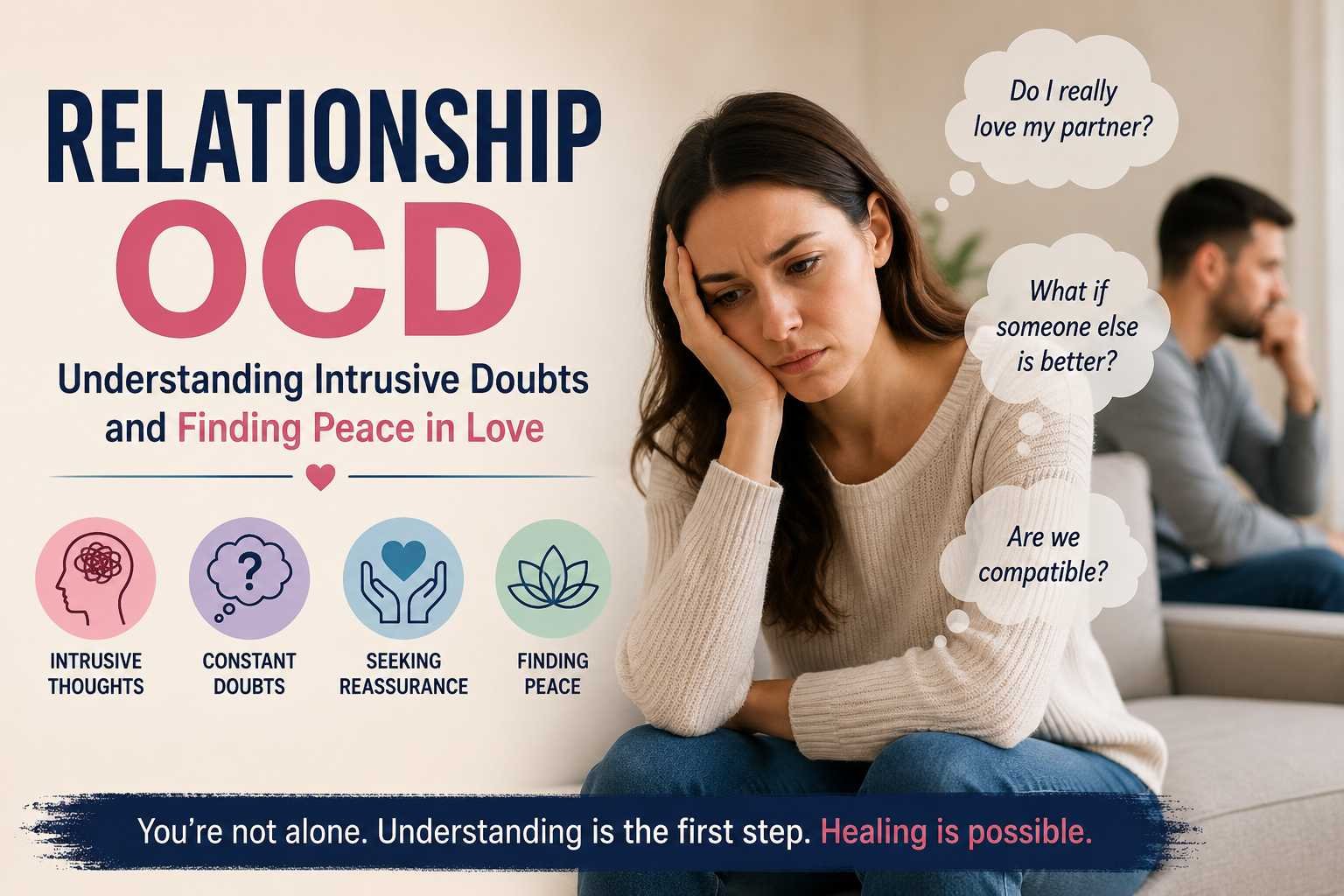
Relationships can naturally involve questions, uncertainty, and occasional doubts. You may wonder whether you are compatible with your partner, whether the relationship will last, or whether you truly feel the way you “should.” For some people, however, these thoughts become persistent, distressing, and difficult to control. Relationship OCD is a term commonly used to describe compulsive symptoms that center on romantic relationships, compatibility, attraction, or feelings toward a partner. Understanding the pattern can help people recognize what is happening and consider ways to respond.
What Is Relationship OCD?
Relationship OCD (often abbreviated as ROCD) is not a diagnosis in the Diagnostic and Statistical Manual of Mental Disorders (DSM-5-TR). Instead, the term is commonly used to describe compulsive symptoms that focus heavily on romantic relationships.
OCD generally involves intrusive thoughts, images, or urges known as obsessions, along with repetitive behaviors or mental acts known as compulsions. These compulsions are often performed to reduce anxiety or obtain certainty.
When OCD symptoms become focused on a relationship, a person may repeatedly question things such as:
- “Do I really love my partner?”
- “What if I am making a mistake?”
- “What if there is someone else for me?”
- “Am I attracted enough to my partner?”
- “What if we’re incompatible?”
- “Should I feel more excited when I see them?”
- “What if my doubts mean I need to end the relationship?”
Having a question about a relationship is normal. The difference is often the intensity, repetition, distress, and compulsive response surrounding the thought.
Common Signs of Relationship OCD

The symptoms can vary considerably from person to person. Someone may experience doubts about their partner, while another person may become focused on their feelings or the relationship’s future.
Here are several common patterns:
1. Constantly Questioning Your Feelings
One pattern involves repeatedly checking whether you feel sufficiently in love.
You might monitor your emotions during conversations, dates, physical affection, or ordinary moments together. If you don’t experience the feeling you expected, you may interpret that temporary emotional state as evidence that something is wrong.
This can create a cycle:
Question $\rightarrow$ Anxiety $\rightarrow$ Checking $\rightarrow$ Temporary reassurance $\rightarrow$ Renewed doubt.
Healthy relationships don’t require you to feel romantic excitement every minute. Feelings naturally fluctuate depending on stress, sleep, work, responsibilities, and many other factors.
2. Comparing Your Relationship With Others
Another sign is excessive comparison.
You might compare your partner with friends’ partners, previous relationships, celebrities, or fictional couples. Social media can make this especially difficult because people generally display the most exciting parts of their relationships online.
You may wonder:
- “Why don’t we have chemistry like they do?”
- “Why doesn’t my partner look like that person?”
- “Why don’t I feel the excitement?”
- “Shouldn’t our relationship be more passionate?”
Occasional comparison is common, but repeatedly using comparisons to seek certainty can reinforce anxiety.
3. Seeking Reassurance
Reassurance can feel comforting when you’re worried. You might repeatedly ask friends, family members, your partner, or online communities whether your relationship is “normal.”
For example:
“Do you think I really love my partner?”
“Would someone in a healthy relationship have these thoughts?”
The problem is that reassurance may provide only temporary relief. Once uncertainty returns, you may feel compelled to ask the question again.
4. Mentally Reviewing the Relationship
Some people repeatedly replay memories and conversations.
You might analyze your date, your partner’s latest comment, or a moment when you didn’t feel particularly romantic. You may try to determine whether a particular event proves that you are compatible—or incompatible.
This type of reviewing can become exhausting because there is rarely a final answer that feels completely certain.
5. Checking Attraction
A person may repeatedly check whether they find their partner attractive.
They might look at photographs, observe their partner’s appearance, or deliberately test their reaction.
Instead of simply noticing attraction naturally, the person may ask:
“Do I feel enough attraction right now?”
The more someone tries to force a particular emotional response, the more difficult it can become to experience the relationship naturally.
What Causes Relationship OCD?

There is no single cause of OCD symptoms. OCD is a condition influenced by multiple biological, psychological, and environmental factors.
People who experience relationship-focused compulsive symptoms may already have a tendency toward anxiety, intrusive thoughts, perfectionism, or an intense desire for certainty.
Relationships can become a powerful focus because they involve uncertainty.
You can never obtain guarantees about:
- whether a relationship will last forever,
- how your feelings will change,
- whether your partner is the “right” person,
- whether another relationship might theoretically be better,
- or exactly how you should feel at every moment.
For someone who struggles with uncertainty, these unanswered questions can become especially uncomfortable.
The Role of Perfectionism
Perfectionism may also contribute to relationship doubts.
Someone might believe that there is a perfect partner, perfect relationship, or perfect feeling they must discover.
This can lead to expectations such as:
“If this is truly the right relationship, I should never have doubts.”
Real relationships involve ambiguity, disagreements, changing emotions, and imperfections.
Relationship OCD vs. Normal Relationship Doubts
This distinction can be difficult.
Almost everyone experiences relationship uncertainty at some point. You may question compatibility after an argument or wonder about the future during a stressful period.
The issue becomes more concerning when thoughts are persistent, intrusive, highly distressing, and accompanied by checking or reassurance-seeking behaviors.
Consider the difference:
| Normal Relationship Uncertainty | Possible OCD-Related Pattern |
| Occasional doubts | Frequent intrusive doubts |
| Questions lead to communication | Questions lead to repeated checking |
| Uncertainty can eventually be tolerated | Uncertainty feels unbearable |
| You evaluate practical concerns | You repeatedly analyze tiny details |
| Reassurance may help normally | Reassurance provides only temporary relief |
| You can redirect attention | Thoughts repeatedly demand attention |
This table isn’t a diagnostic test. Only a qualified mental-health professional can properly assess OCD or another mental-health condition.
How Relationship OCD Can Affect a Relationship

The effects can extend beyond the person experiencing the thoughts.
Constantly analyzing the relationship may make ordinary interactions feel like tests.
A date may become an opportunity to determine whether you feel excitement. A hug may become a test of attraction. An argument may become evidence that you’re incompatible.
This can reduce spontaneity and emotional connection.
Reassurance-seeking can also place pressure on a partner. If someone repeatedly asks, “Do you think I love you enough?” or “Are we definitely right for each other?”, the partner may eventually feel responsible for managing the person’s anxiety.
Avoidance can create another problem.
Someone might avoid activities because they are afraid those activities will trigger more doubts. Over time, avoidance can reduce opportunities to experience the relationship normally.
How to Cope With Relationship OCD
If compulsive symptoms are interfering with your life or relationship, professional support can be valuable.
There are also strategies that may help you understand the pattern:
1. Recognize the Cycle
The first step is recognizing that intrusive thoughts and compulsive responses can reinforce one another.
For example:
- Intrusive thought: “What if I don’t love my partner enough?”
- Anxiety: “I need to figure this out.”
- Compulsion: Checking feelings, analyzing memories, searching, or asking for reassurance.
- Relief: “Maybe everything is okay.”
- New doubt: “But what if I missed something?”
Understanding this cycle can make it easier to notice when you’re being pulled into another round of checking.
2. Don’t Treat Every Thought as a Fact
An intrusive thought is not automatically meaningful.
The thought “What if I’m with the wrong person?” doesn’t prove that you are with the wrong person.
Likewise, temporarily feeling emotionally flat doesn’t automatically mean that love has disappeared.
Learning to distinguish between having a thought and believing a thought can be useful.
3. Reduce Reassurance-Seeking
Repeated reassurance may feel helpful in the moment, but it can maintain an obsessive-compulsive cycle.
Instead of repeatedly asking someone to confirm that your relationship is okay, consider practicing tolerance for uncertainty.
This doesn’t mean ignoring real relationship problems. It means avoiding attempts to achieve absolute certainty about questions that cannot have absolute answers.
4. Stop Testing Your Feelings
Trying to make yourself feel love, attraction, excitement, or sureness can make emotions seem more artificial.
Instead of always asking yourself:
“Am I feeling something right now?”
try focusing on the real experience you’re having with your partner.
Enjoy the conversation. Cook together. Take a walk. Watch a movie. Have a moment without turning it into an emotional test.
5. Learn to Handle Uncertainty
One core aspect of managing OCD is accepting that you can’t always have complete sureness.
You can’t know everything about what will happen in your relationship.
Instead of trying to get rid of all the “what if” thoughts, you can slowly learn that uncertainty is uncomfortable but manageable.
This concept is central to evidence-based treatments for OCD.
Treatment for Relationship OCD

When compulsive symptoms cause significant disruption in daily life or relationships, speaking with a trained mental health professional is a key step.
Exposure and Response Prevention
Exposure and Response Prevention (ERP) is a primary treatment for OCD.
ERP involves facing situations, thoughts, or uncertainties that cause anxious feelings while learning not to perform compulsive actions.
For relationship-focused symptoms, treatment might include learning to handle not knowing how you feel or whether you are right for each other without checking, overthinking, or asking for reassurance.
ERP should be conducted with a professional who specializes in OCD and can tailor the treatment to the individual.
Cognitive Behavioral Therapy
Cognitive Behavioral Therapy (CBT) can also help with OCD. It helps people identify thinking and behavior patterns and find healthier ways to respond.
For someone with intrusive thoughts about relationships, therapy might explore beliefs about certainty, perfection, responsibility, and the meaning assigned to intrusive thoughts.
Medication
Medication may be appropriate for some individuals with OCD. Selective Serotonin Reuptake Inhibitors (SSRIs) are commonly prescribed for OCD symptoms.
Medication options should be discussed with a healthcare professional who can evaluate a person’s individual situation, medical history, and potential side effects.
How to Help a Partner with Relationship OCD
If your partner struggles with relationship doubts, it can be hard to know how to respond.
You can offer kindness without taking on the role of making their anxiety go away.
Try to:
- Listen without being judgmental.
- Encourage seeking professional help when appropriate.
- Avoid getting drawn into reassurance loops.
- Learn about OCD from reliable sources.
- Maintain healthy boundaries.
- Remember that intrusive thoughts don’t always reflect true feelings or mean the relationship is wrong.
You can say something like:
“I know those thoughts are really hard. I’m here for you, but I don’t think checking over and over again will help you feel better.”
The best way to help depends on the situation and should ideally be discussed with a trained professional.
When Relationship Doubts Might Be About the Relationship

Not every worry about a relationship is OCD.
A person might have valid reasons to question a relationship, including:
- being mistreated repeatedly,
- being lied to,
- being controlled,
- having incompatible long-term goals,
- experiencing emotional or physical harm,
- encountering persistent communication problems,
- having core value differences,
- or feeling unsafe.
The goal isn’t to label every doubt as an obsession.
A mental health expert can help differentiate between OCD patterns and genuine relationship issues.
It’s also important to recognize that someone can experience OCD and have real relationship problems at the same time.
Relationship OCD and Social Media
Social media can exacerbate relationship comparisons.
Curated photos of trips, surprise proposals, celebrations, and affectionate messages can convey a false impression that happy couples are always filled with passion and certainty.
Real relationships involve quiet days, arguments, stress, and fluctuating emotions.
If online content frequently triggers comparison or checking behaviors, taking a break from relationship-focused media can be helpful.
Instead of wondering if your relationship matches what you see online, focus on your own values and the authentic moments you share.
Questions to Think About
If you’re trying to understand your worries about your relationship, consider these questions:
- How often do you evaluate your feelings for your partner?
- Do you frequently ask others for reassurance?
- Do you constantly check your emotional or physical reactions?
- Do you search the internet for definitive answers about your relationship?
- Do you repeatedly compare your relationship to others?
- Do you avoid certain activities because they trigger relationship doubts?
- Do these thoughts interfere with your work, sleep, social life, or intimacy?
- Can you tolerate not knowing the answer right away?
These questions are not a diagnostic tool for OCD, but they can help identify patterns worth discussing with a mental health professional.
Frequently Asked Questions About Relationship OCD
What is relationship OCD?
Relationship OCD is a term used to describe OCD symptoms centered around romantic relationships. It can involve persistent doubts about love, attraction, compatibility, or the future, as well as compulsions like checking, ruminating, comparing, or seeking reassurance.
Is relationship OCD a formal diagnosis?
The term ROCD is commonly used to describe relationship-focused OCD symptoms, but it is not a standalone diagnosis in the DSM-5-TR. A qualified clinician can determine whether symptoms align with OCD or another condition.
Does relationship OCD mean you don’t love your partner?
No. Having intrusive doubts does not mean you lack love for your partner. OCD often targets what people value most, causing them to question feelings they wouldn’t otherwise fixate on.
Can relationship OCD go away?
OCD symptoms can be effectively managed. Many people learn to navigate them successfully using evidence-based therapies like ERP and CBT, which reduce compulsive behaviors and build tolerance for uncertainty.
Should I end my relationship if I have relationship OCD?
Experiencing OCD thoughts does not automatically mean you should break up. Major relationship decisions are best made based on the overall health and values of the relationship, rather than an urge to seek certainty through compulsions.
How do I stop checking my feelings?
Trying to suppress thoughts immediately can often backfire. A more effective approach is to notice the urge to check and, ideally with professional guidance, practice tolerating uncertainty without performing the checking behavior.
Can reassurance make relationship OCD worse?
While reassurance provides short-term relief, it can reinforce the cycle of compulsions over time. A therapist specializing in OCD can help develop healthier strategies for managing uncertainty.
When should I see a professional?
Consider seeking professional support if relationship thoughts cause significant distress, consume a large amount of time, interfere with daily functioning, or lead to repetitive checking and reassurance-seeking.
Summary
Relationship OCD can amplify normal relationship uncertainty. Repeated doubts about love, attraction, compatibility, or the future can lead to checking, comparing, ruminating, seeking reassurance, and avoidance. While these actions might offer temporary relief, they ultimately perpetuate the cycle.
Recognizing the distinction between typical concerns and compulsive OCD patterns is an important first step. Evidence-based treatments like ERP and CBT can help individuals develop new responses to intrusive thoughts and build tolerance for uncertainty.
Crucially, you don’t need to have absolute certainty about every aspect of your relationship. Healthy relationships naturally involve shifting feelings, mistakes, disagreements, and moments of ambiguity. If intrusive thoughts are significantly impacting your life or relationship, consider consulting a mental health professional trained in treating OCD.