
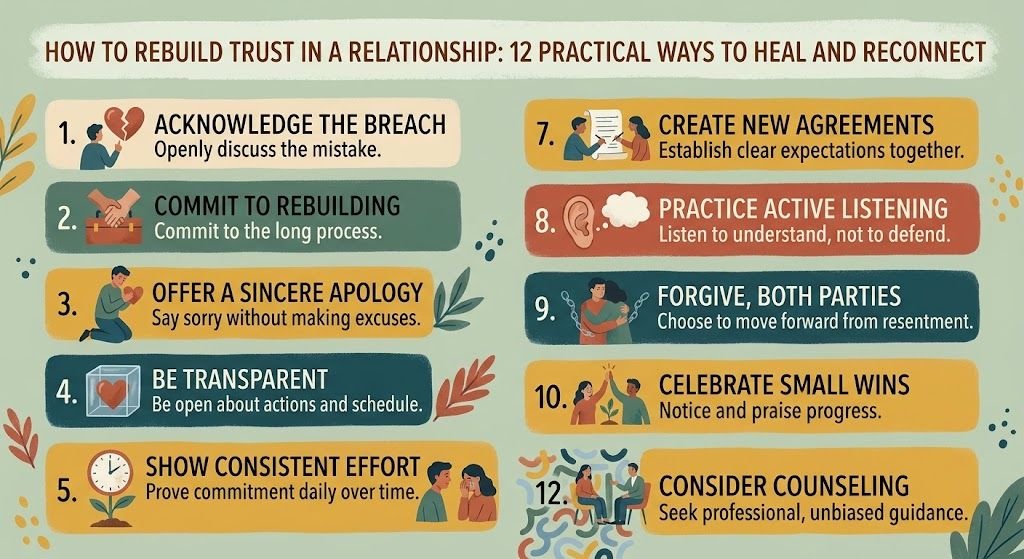
Trust is one of the most important foundations of a healthy partnership, but it can be damaged by dishonesty, broken promises, emotional distance, infidelity, secrecy, or repeated misunderstandings. If you and your partner are trying to move forward after a difficult experience, learning how to rebuild trust in a relationship can help you create a stronger and more secure connection. Rebuilding trust does not happen overnight. It requires patience, honesty, accountability, consistent behavior, and a genuine willingness from both partners to repair what has been damaged.
Whether the problem was a single mistake or a long period of disappointment, relationships can often recover when both people are committed to making meaningful changes. The goal is not to pretend that nothing happened. Instead, it is to understand what went wrong, address the underlying problems, and gradually create experiences that make the bond feel safe again.
What Does Trust Really Mean in a Relationship?
Trust means believing that your partner is dependable, honest, respectful, and emotionally safe. It allows you to communicate openly without worrying about being deceived, ignored, judged, or abandoned.
Trust is not simply about believing that your partner will never make a mistake—everyone makes mistakes. Instead, healthy trust develops when both people know that problems will be handled honestly and responsibly.
A trusting relationship often includes:
- Respectful communication
- Keeping reasonable promises
- Emotional availability
- Honesty about difficult issues
- Respect for personal boundaries
- Consistent day-to-day behavior
- Taking full responsibility for mistakes
- Feeling safe enough to express concerns
When trust has been damaged, even small situations can trigger strong emotional reactions. A late reply, a changed plan, or unexplained behavior may create anxiety because previous experiences changed how one partner interprets situations. Understanding how to rebuild trust in a relationship requires recognizing that the hurt partner needs both time and evidence before feeling secure again.
Why Does Trust Break Down?
Trust can be damaged in many different ways. Infidelity is a primary example, but it is certainly not the only reason couples struggle. A partner may lose trust because of repeated lying, hiding information, breaking commitments, emotional infidelity, sharing private information, refusing to communicate, or repeatedly dismissing the other person’s feelings.
Sometimes trust disappears gradually rather than through one dramatic event. For example, a partner may repeatedly promise to spend quality time together but never follow through. Individually, each broken promise may seem minor. Over time, however, the pattern communicates that the relationship is not a priority.
Understanding the root cause of the damage is essential. You cannot effectively figure out how to rebuild trust in a relationship if you do not understand what caused it to break in the first place.
12 Practical Steps to Repair Your Connection

1. Be Completely Honest About What Happened
The first step toward repairing damaged trust is transparent communication. Avoid minimizing the situation or changing the story to make yourself look better. If you made a mistake, acknowledge it fully. If you were hurt, explain what happened and how it affected you. While honest conversations can feel uncomfortable, avoiding difficult subjects usually creates more uncertainty.
2. Take Full Responsibility for Your Actions
An apology becomes meaningful only when it includes complete accountability. Instead of saying, “I’m sorry you feel that way,” acknowledge your specific behavior. Explain what you did, recognize why it was harmful, and avoid blaming your partner for your decision.
3. Give the Hurt Partner Time to Heal
One of the biggest mistakes couples make when exploring how to rebuild trust in a relationship is expecting trust to return immediately after an apology. An apology happens in a single conversation, but emotional healing often takes much longer. The person who was hurt may continue to experience sadness, anger, confusion, or insecurity.
4. Communicate Clearly and Openly
Poor communication creates uncertainty, assumptions, and unnecessary conflict. Make an effort to discuss expectations explicitly instead of expecting your partner to guess what you need. Talk about boundaries, plans, emotional needs, and concerns before resentment builds.
5. Keep Your Promises Consistently
Consistency is the single most effective way to demonstrate that your behavior has genuinely changed. If you promise to call, call. If you agree to communicate openly, follow through. Small promises matter because trust is rebuilt through daily experiences rather than grand gestures.
6. Establish Healthy Boundaries Together
Boundaries provide structure while a relationship is recovering. Depending on the situation, boundaries may involve communication with third parties, social media usage, privacy, finances, shared time, or conflict management. Healthy boundaries should be mutually agreed upon and reasonable—never tools for controlling or monitoring another person.
7. Stop Hiding Problems and Practice Transparency
When people are afraid of conflict, they sometimes hide problems until they become much larger. Unfortunately, secrecy damages trust even when the original issue might have been manageable. If something is bothering you, discuss it early. If you made a mistake, acknowledge it before your partner discovers it elsewhere.
8. Show Genuine Empathy for Your Partner’s Feelings
When learning how to rebuild trust in a relationship, showing empathy is crucial. When trust has been damaged, the hurt person may experience emotions that seem disproportionate to the current event. Instead of criticizing their reaction, try to understand what is driving it. Validate their feelings by recognizing that their perspective makes sense given what happened.
9. Avoid Using the Past as a Weapon
Healing becomes impossible when every disagreement turns into a reminder of a past mistake. If you have decided to work on the relationship, try to distinguish between discussing the past for healing and using the past to punish. While the past may need to be discussed during early recovery, the relationship eventually needs opportunities to create new, positive experiences.
10. Create New Positive Experiences Together
After trust is damaged, couples can become focused entirely on their problems. Creating new experiences helps restore emotional connection. Spend quality time together, try a new activity, cook a meal, take a walk, or simply have a lighthearted conversation without discussing conflict.
11. Be Patient With Emotional Setbacks
Recovery is rarely a straight line. You may have several good weeks followed by a difficult conversation that brings old emotions back to the surface. Triggers can happen unexpectedly—certain dates, places, messages, or situations may remind someone of what happened. Focus on progress over time rather than judging your relationship by one difficult day.
12. Consider Professional Relationship Counseling
Some trust issues are difficult to resolve without outside help. If communication keeps turning into destructive arguments, if the same problems keep happening without resolution, or if both people feel stuck, going to couples counseling can provide a safe environment to navigate complex emotions.
Specific Strategies for Common Scenarios

How to Fix Trust After Someone Lied
Lying makes people question what else might be hidden. If someone was dishonest, understanding how to rebuild trust in a relationship after lying requires more than promising not to lie again. The person who lied needs to understand why they chose to lie—was it fear of conflict, shame, or bad communication habits? Identifying the cause helps prevent the behavior from recurring.
How to Fix Trust After Cheating
Cheating makes people feel unsafe, distant, and uncertain about the future. Couples who want to stay together must discuss why the infidelity happened, confirm that the affair partner is completely out of their lives, establish clear boundaries, and determine what structural changes are needed to ensure it never happens again.
How to Fix Trust When Your Partner Is Emotionally Distant
Feeling emotionally distant can weaken trust over time. If your partner is pulling away, don’t jump to the worst conclusion right away. Instead, find a quiet time to talk honestly about how you both feel about the current state of the relationship.
How to Fix Trust Without Losing Yourself
Fixing a relationship should never mean losing your identity, independence, or self-respect. While working on how to rebuild trust in a relationship, remember that trust cannot grow out of constant surveillance or control. Checking phones or tracking locations may offer brief reassurance, but real trust comes from voluntary openness and consistency.
Key Indicators of Recovery

Signs That Trust Is Getting Better
Trust is returning when:
- Conversations become less defensive and angry.
- Daily promises are kept consistently.
- Both partners feel safe talking about problems.
- Conflicts are resolved more smoothly.
- Actions consistently match spoken words.
- The urge to constantly check up on each other decreases.
- Emotional intimacy and closeness begin to return naturally.
Signs That the Relationship May Need Help
Not every relationship can or should be saved. It may be time to re-evaluate the partnership if lies continue, agreed-upon boundaries are ignored, one partner refuses to take responsibility, or you feel unsafe or controlled. Trust cannot be rebuilt by one person working alone.
Frequently Asked Questions
1. Can trust really come back after it is broken?
Yes, trust can be restored. It depends on the severity of the issue, how much both partners want to change, and their actions over time.
2. How long does it take to figure out how to rebuild trust in a relationship?
There is no fixed timeline. Small breaches may take weeks, while major betrayals can take months or years. Continuous progress matters more than a specific deadline.
3. Should I forgive my partner right away?
No. Forgiveness is a process, not a requirement to be rushed. Take the time you need to evaluate whether your partner’s actions match their words.
4. Can trust come back without an apology?
It is extremely difficult. A genuine apology shows accountability and recognition of the pain caused, laying the foundation for action.
5. What if my partner keeps lying?
Repeated lying indicates a deeper pattern. Set firm boundaries, and evaluate whether the relationship provides the safety and respect you deserve.
6. Should couples go to counseling after trust is broken?
Yes. Professional guidance helps couples break negative communication loops and work through trauma safely.
7. Can a relationship get stronger after trust is broken?
Yes. Many couples develop deeper intimacy and clearer boundaries after working through a major crisis together.
8. How do I know if my partner has really changed?
Look at their long-term patterns, not short-term promises. Genuine change is reflected in consistent honesty, patience, and accountability over time.
9. Should I keep checking my partner’s phone after they lied?
Monitoring can provide short-term reassurance, but it prevents long-term trust from forming. Focus instead on agreeing upon mutual transparency.
10. What if I was the one who broke the trust?
Take full responsibility without making excuses. Answer questions patiently, respect your partner’s timeline for healing, and demonstrate change through action.
11. What is the most important part of rebuilding trust?
Consistency. Words express intent, but long-term actions prove true transformation.
12. What if the relationship can’t get better?
If dishonesty persists or the relationship remains toxic, ending it may be the healthiest choice for your well-being.
Final Thoughts
Understanding how to rebuild trust in a relationship takes time, honesty, mutual accountability, and continuous effort. Trust is not restored through a single conversation—it grows through small daily moments where both partners demonstrate that they are reliable, open, and dedicated to a shared future.