
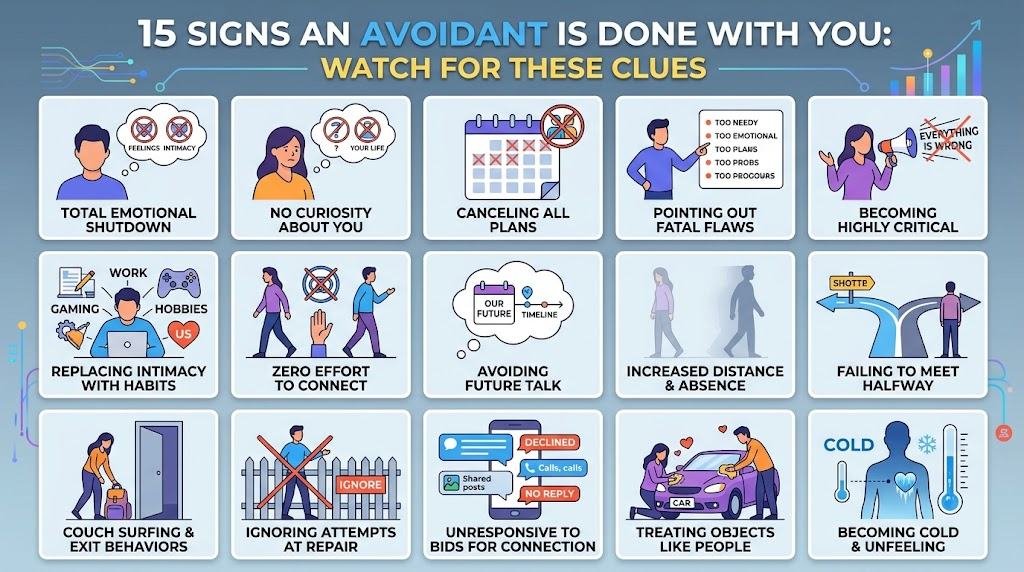
Understanding the signs an avoidant is done with you can be confusing, especially when someone with an avoidant attachment style tends to withdraw, become distant, or struggle with emotional intimacy. Not every period of distance means a relationship is ending. Avoidant people may need space when they feel overwhelmed. However, there are important differences between temporarily pulling back and emotionally checking out of a relationship.
If you are experiencing decreased communication, reduced affection, emotional detachment, or a partner who no longer seems interested in repairing problems, you may wonder whether the relationship is coming to an end. Learning how to recognize these patterns can help you respond calmly rather than constantly guessing what the other person is thinking.
1. Understanding Avoidant Attachment
What Does an Avoidant Attachment Style Mean?
Avoidant attachment generally describes a pattern in which a person feels uncomfortable with too much emotional closeness or dependence. Someone with avoidant tendencies may value extreme independence, have difficulty expressing vulnerable feelings, or become uncomfortable when a relationship becomes highly intimate.
This does not automatically mean an avoidant person does not love their partner. In fact, an avoidant individual can care deeply about someone while still struggling with emotional intimacy.
However, when an avoidant partner decides that a relationship is no longer right for them, their behavior may change noticeably. They may stop investing effort, communicate less, or become increasingly detached.
2. 15 Signs an Avoidant Is Done With You

1. They Stop Making an Effort
One of the clearest signs an avoidant is done with you is a noticeable decrease in effort.
Relationships require participation from both people. If your partner previously made plans, checked on you, initiated conversations, or tried to make you happy, but suddenly stops doing those things, it may indicate emotional disengagement.
The important factor here is consistency. Everyone has days or short periods when they need extra personal space. However, when the lack of effort continues for weeks and there is little interest in changing the situation, something deeper may be happening.
2. Communication Becomes Extremely Minimal
An avoidant partner may naturally prefer less frequent communication than someone with a secure attachment style. However, there is a distinct difference between needing temporary space and completely losing interest in communication.
You might notice that:
- They rarely initiate conversations.
- Their replies become short, cold, and impersonal.
- They stop asking about your day.
- Everyday conversations feel forced or awkward.
- They frequently leave messages unanswered.
- They no longer discuss relationship issues.
If communication has changed dramatically and remains distant over time, it can be a significant warning sign.
3. They No Longer Try to Reconnect After Pulling Away
Avoidant people may sometimes withdraw when they feel emotionally overwhelmed. They may need time alone before returning to the relationship.
A significant difference occurs when they stop coming back emotionally.
Previously, they might have taken some space and then contacted you again, perhaps apologizing, explaining their feelings, or acting affectionate afterward. If they now disappear emotionally without making any attempt to reconnect, this suggests that their withdrawal is becoming permanent.
4. They Become Detached
Emotional detachment is another primary indicator.
You may feel that your partner is physically present but emotionally somewhere else. They may listen without truly engaging, respond without showing emotion, or appear indifferent to ongoing relationship problems.
You could find yourself thinking, “Why does it feel like they don’t care anymore?”
This emotional distance can be especially painful because there may not be an explosive breakup or obvious conflict. Instead, the relationship slowly begins to feel empty.
5. They Stop Talking About the Future
Another possible sign is that your partner stops including you in prospective plans.
Previously, they may have talked about:
- Vacations
- Moving in together
- Marriage
- Upcoming holidays
- Career plans
- Meeting family
- Long-term goals
Now, conversations about the future may disappear completely. While avoidant individuals naturally hesitate around long-term commitment discussions, if future planning suddenly vanishes alongside affection, communication, and effort, it deserves serious attention.
6. They No Longer Seem Interested in Resolving Problems
Every relationship faces disagreements. Healthy relationships do not require absolute harmony; what matters is whether both people are willing to repair problems together.
One of the most concerning signs an avoidant is done with you is when they no longer care whether conflicts are resolved.
They may say things such as:
- “It doesn’t matter.”
- “Do whatever you want.”
- “I’m tired of talking about this.”
- “There’s nothing to discuss.”
- “It is what it is.”
These statements often indicate emotional resignation.
7. They Become Comfortable With Losing You
Perhaps the clearest indication that someone has emotionally checked out is their total indifference to the possibility of losing the relationship.
If your partner previously cared when the relationship was threatened, but now appears completely indifferent, their emotional investment has likely shifted. For example, if you tell them that their behavior is hurting the relationship and they respond with apathy rather than concern, it indicates that they no longer feel motivated to maintain the connection.
8. Physical Affection Decreases Dramatically
Physical affection often wanes when emotional investment decreases.
Your partner may stop:
- Hugging you
- Holding your hand
- Sitting close to you
- Initiating intimacy
- Giving reassuring touches
- Showing physical warmth
A temporary decrease does not necessarily mean the relationship is ending, as stress, exhaustion, or personal problems can affect affection. However, a persistent decline accompanied by emotional distance and communication issues can be very telling.
9. They Start Treating the Relationship Like an Obligation
When someone becomes emotionally disconnected, spending time together may start feeling like a burdensome responsibility rather than something they genuinely enjoy.
They may stop spending quality time with you, avoid setting dates, or frequently find reasons not to be together. You may notice that they seem much happier when they are alone or with other people.
Independence itself is healthy, but the issue arises when your partner consistently avoids connection specifically with you.
10. They Stop Sharing Things With You
Emotional intimacy involves sharing thoughts, daily experiences, concerns, dreams, and personal vulnerabilities.
If your partner used to tell you about their life but now keeps everything to themselves, that is another warning sign.
They may stop telling you:
- How they feel
- What they are worried about
- What happened during their day
- Their personal goals
- Their emotional struggles
- Their opinions about the relationship
When someone stops allowing you into their internal world, emotional distance is growing rapidly.
11. They Seem Irritated by Your Presence
An avoidant person who has emotionally checked out may become increasingly irritated by normal relationship interactions.
Small things that previously did not bother them may suddenly become triggers for frustration. They may complain about:
- How you text
- Spending time together
- Asking questions
- Showing affection
- Discussing feelings
- Making plans
The issue may not be that you are doing anything wrong; rather, their emotional tolerance for closeness in the relationship has significantly dropped.
12. They Avoid Relationship Conversations Completely
There is a distinct difference between needing time to process thoughts and refusing to discuss the relationship at all.
If every attempt to discuss your concerns is met with avoidance, changing the subject, walking away, or refusing to participate, the relationship is in serious trouble. Someone who wants to maintain a bond will generally show a willingness to communicate eventually.
13. They Stop Showing Curiosity About You
Interest is a fundamental part of an emotional connection.
A partner who remains invested will usually want to know what you think, how you feel, and what is happening in your life. If they stop asking questions and seem uninterested in your experiences, you may begin to feel invisible. This is particularly meaningful if it represents a stark change from how they behaved earlier in the relationship.
14. They Tell You They Don’t Want a Relationship
Sometimes people spend a lot of time analyzing subtle behaviors when the person has already communicated their decision directly.
If an avoidant partner explicitly says they do not want a relationship, do not want commitment, or no longer have feelings, it is vital to take their words at face value. You do not need to decode every action when someone has clearly stated their stance. Respecting their decision also protects your emotional well-being.
15. You Feel Like You Are the Only One Fighting for the Relationship
Perhaps one of the strongest signs an avoidant is done with you is that you are doing all the work to hold the connection together.
You may find yourself:
- Starting every conversation
- Planning every date
- Trying to resolve every conflict
- Constantly asking for affection
- Reassuring them repeatedly
- Trying endlessly to understand their behavior
- Attempting to save the relationship alone
A healthy relationship cannot be sustained by one person’s effort indefinitely. If you constantly have to convince someone to participate, it may be time to step back and evaluate what you are actually receiving in return.
3. Avoidant Withdrawal vs. Being Completely Done

Distinguishing between temporary withdrawal and being completely “done” is extremely important.
An avoidant person might pull away for a while due to stress, fear of intimacy, or feeling emotionally overwhelmed. That does not always mean they are abandoning the relationship. Often, after having some time to regulate, they will return with an apology, reassurance, or a renewed effort to connect.
Being “done” is different. When someone is truly done, they are no longer trying to repair things. They aren’t seeking solutions, asking questions, reaching out, or showing concern.
That is where the line gets blurry, making it easy to hold onto hope if you still care deeply. However, if you are putting all your energy into a relationship where the other person is not matching your effort, there is a clear imbalance.
Ask yourself:
- Are they open to working through issues?
- Do they express any desire to stay?
- Are they making genuine efforts to reconnect?
- Are they just staying around by default?
If the answer to these questions is mostly “no,” then the signs an avoidant is done with you are likely real and clear.
4. Why Avoidants Pull Away & What to Do

Why Do Avoidant People Pull Away?
Avoidant behavior often stems from deep-rooted causes. Some people learned early in life that relying on others was unsafe or unreliable, developing extreme independence as a defense mechanism.
As adults, when emotional closeness or pressure increases, they instinctively protect themselves by creating distance. However, an attachment style should never be used as an excuse for hurtful behavior. A person can have avoidant tendencies and still communicate honestly, respect boundaries, and treat their partner with care.
Should You Chase an Avoidant Who Is Pulling Away?
Constantly chasing someone who is withdrawing creates an exhausting pursue-and-distance cycle.
You pursue more because you feel disconnected; they view your increased pursuit as pressure and withdraw further, causing you to become more anxious and pursue harder. Instead of repeatedly demanding reassurance, communicate your needs clearly and give the other person space to respond. Remember: healthy space is very different from being ignored or stonewalled.
What Should You Do If You Think an Avoidant Is Done?
If you recognize these signs, try not to panic immediately. Start by objectively analyzing the pattern:
- Has their behavior changed significantly?
- How long has this change lasted?
- Have they clearly communicated what they need?
- Are they willing to discuss the relationship?
- Are they making any effort to repair problems?
- Are you doing most of the relational work?
- Do their words line up with their actions?
Next, initiate one calm, honest conversation. Instead of accusing them, explain what you have observed and how it affects you.
Example:“I’ve noticed that we’ve become more distant recently. I care about this relationship, but I don’t want to keep guessing where we stand. I would like to understand whether you still want to work on this together.”
This approach gives your partner a clear, non-confrontational opportunity to be honest.
Don’t Try to Convince Someone to Love You
One of the most important lessons in relationships is accepting that you cannot force emotional availability. You can communicate, listen, compromise, and work on yourself, but you cannot make another person want to be in a relationship.
If someone consistently demonstrates that they do not want to continue, respecting their decision is far healthier than trying to change their mind. Your self-worth does not depend on whether an avoidant person chooses to stay.
What If the Avoidant Comes Back?
Avoidant partners sometimes return after periods of distance. If that happens, do not automatically assume everything has permanently changed. Look for tangible evidence of growth, such as:
- Consistently better communication
- Sustained daily effort
- Greater emotional openness
- Respect for your emotional needs
- Willingness to discuss difficult topics
- True accountability for past behavior
- A realistic plan for improving the relationship
A return without real behavioral change usually restarts the exact same painful cycle.
Frequently Asked Questions (FAQs)
What are the biggest signs an avoidant is done with you?
Common signs include permanent emotional detachment, minimal or cold communication, total lack of effort, avoidance of relationship discussions, no interest in resolving conflict, absence of affection, and indifference toward the future of the relationship.
Does an avoidant person stop loving you when they pull away?
Not necessarily. Avoidant people frequently pull away because they feel overwhelmed by emotional closeness or stress. Pulling away on its own does not mean love has vanished; the broader long-term pattern and their communication are much more important indicators.
How do you know if an avoidant needs space or is done?
Someone who simply needs space will usually communicate their need for time and eventually make an effort to reconnect. Someone who is done will show consistent indifference, stop investing, avoid meaningful conversations, and display no desire to repair the bond.
Will an avoidant come back after ending a relationship?
Some avoidant individuals do attempt to reconnect after a breakup once the pressure subsides, while others do not. However, a return does not automatically mean they have processed their issues or are ready for a healthy, committed relationship.
Should you chase an avoidant who is pulling away?
No. Chasing someone who is withdrawing usually triggers a pursue-and-distance cycle that leaves both partners drained. It is generally better to express your needs calmly, respect reasonable boundaries, and observe whether they make a mutual effort.
Can a relationship with an avoidant become healthy?
Yes. Attachment styles are not unchangeable personality labels. People can develop secure communication and relationship skills through self-awareness and therapy. However, both partners must be genuinely willing to acknowledge their patterns and work toward change.
How long does avoidant withdrawal usually last?
There is no universal timeline. Some individuals may only need a few days of space to regulate, while others may withdraw for weeks or longer. What matters most is whether they communicate their needs and eventually make an active effort to reconnect.
What should I do if an avoidant says they are done?
Take their words seriously. You can ask for brief clarification, express your feelings, and determine if there is any mutual desire to work things through. If they have made up their mind, accepting their decision will help you begin moving forward.
Conclusion
Recognizing the signs an avoidant is done with you is not about assigning blame—it is about gaining emotional clarity. Needing space does not necessarily mean an avoidant partner has stopped caring. However, persistent emotional detachment, a total lack of effort, minimal communication, a refusal to address problems, and complete indifference toward the relationship indicate that they have emotionally checked out.
Remember that you deserve a partnership where communication, affection, respect, and effort are fully mutual. You should not have to spend all your energy decoding another person’s behavior or convincing them to stay.
When someone genuinely wants to build a life with you, their actions will eventually provide clarity. If their words and actions consistently show they are no longer invested, accepting the reality of the situation is the healthiest choice you can make for yourself.
1 thought on “Signs an Avoidant Is Done With You: 15 Signs to Watch For”