
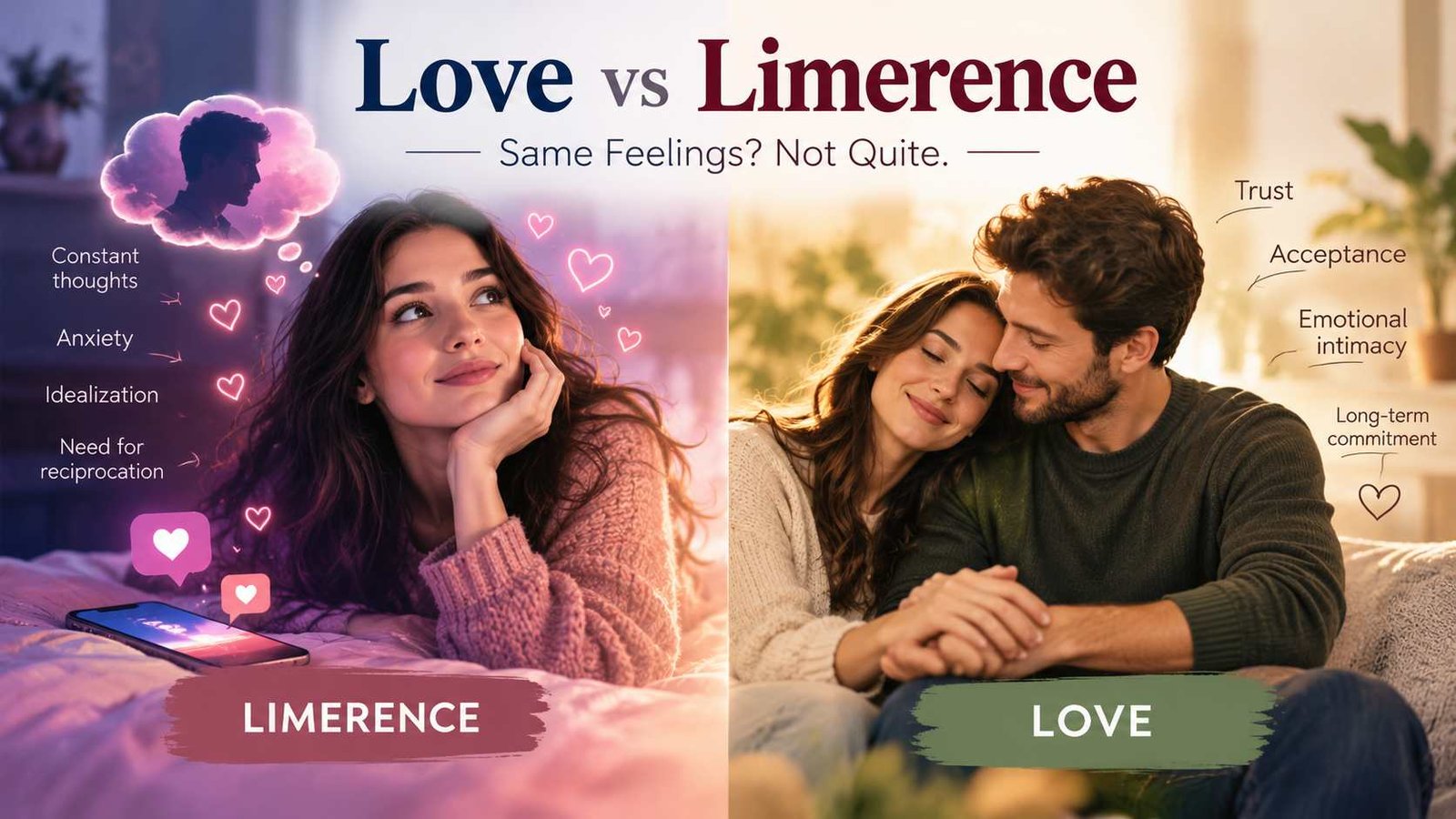
Understanding love vs limerence can be surprisingly difficult, especially when strong emotions make a new relationship feel extraordinary. You may think about someone constantly, feel a deep emotional connection, or become convinced that this person is uniquely right for you.
However, powerful attraction does not always mean lasting love. Sometimes, what feels like love may actually be limerence—a state of infatuation characterized by persistent thoughts, emotional highs and lows, and a strong desire for reciprocation.
Both experiences can feel exciting and meaningful, but they are fundamentally different. Love generally develops through trust, emotional intimacy, acceptance, shared experiences, and consistent care. Limerence tends to be driven by idealization, uncertainty, anticipation, and the desire to be wanted by another person.
Knowing the difference can help you understand your feelings, make healthier relationship decisions, and avoid confusing emotional intensity with genuine compatibility.
What Is Limerence?

Limerence is a term used to describe a state of intense romantic infatuation. Someone experiencing limerence may spend an immense amount of time thinking about another person and looking for signs that their feelings are returned.
The experience can feel consuming. A simple text message may create excitement, while a delayed response can cause anxiety or disappointment. Small, everyday interactions can seem deeply meaningful.
Common Signs of Limerence
- Constantly thinking about someone
- Idealizing their personality or appearance
- Feeling unusually excited by signs of attention
- Worrying about whether they feel the same way
- Replaying conversations repeatedly in your head
- Looking for hidden meanings in messages or behaviors
- Experiencing drastic emotional highs and lows
- Imagining a future before truly knowing the person
- Feeling disappointed when reality does not match your expectations
Importantly, limerence is not inherently bad; it can be a normal part of the early stages of romantic attraction. The problem occurs when intense infatuation is mistaken for a deep understanding of another person or the foundation of a healthy, long-term relationship.
What Is Love?

Love is generally more stable and grounded than infatuation. Although love can involve passion and excitement, it also provides safety, respect, trust, acceptance, and commitment.
Healthy romantic love develops as two people learn who they really are. Instead of loving only an idealized version of someone, you gradually learn to understand and accept their strengths, weaknesses, habits, values, and imperfections.
Core Elements of Real Love
- Mutual respect
- Emotional support and trust
- Honest communication
- Acceptance of imperfections
- Shared responsibility and healthy boundaries
- Reliability and vulnerability
- Long-term commitment
- Genuine concern for each other’s well-being
Real love does not mean a relationship is always easy. Couples can disagree, experience disappointment, and go through difficult periods. What distinguishes love is often the willingness to communicate, resolve problems, and continue treating each other with care.
Love vs Limerence: Key Differences Explained

The clearest way to understand love vs limerence is to compare what each experience is primarily based on:
- Limerence focuses heavily on emotional intensity and reciprocation. You may feel wonderful when the person gives you attention, but distressed when they seem distant.
- Love focuses on knowing and accepting the person as they actually are. You care about their happiness even when you are not actively receiving validation from them.
Another major difference is stability. Limerence fluctuates dramatically depending on the other person’s behavior, whereas love maintains a deeper sense of underlying security despite temporary emotional shifts.
1. Intensity vs. Stability
Limerence often feels extremely intense—your emotions may seem stronger than anything you have experienced before. Love can also be passionate, but it tends to become more emotionally stable as the relationship develops. Intensity alone does not prove that a connection is stronger; sometimes, uncertainty actually increases intensity because your mind is constantly waiting for reassurance.
2. Fantasy vs. Reality
Limerence frequently involves idealization. You may focus on who someone could become rather than who they currently are, imagining that the person is perfect for you despite knowing little about them. Love, on the other hand, develops through reality. You see the person’s imperfections and discover that they won’t always behave as expected, yet you decide whether the relationship remains meaningful and healthy.
3. Needing Reciprocation vs. Giving
One of the clearest differences in love vs limerence involves the need for reciprocation. Limerence is strongly dependent on knowing that the other person wants you—their attention becomes emotionally rewarding, while uncertainty becomes painful. Love values affection, but it centers on genuine concern for the other person’s needs through giving, supporting, listening, and respecting.
4. Anxiety vs. Security
Limerence can create a cycle of anticipation and anxiety, leading you to repeatedly check your phone, analyze messages, or wonder why someone has not contacted you. While healthy love can still involve early insecurity, trust and open communication gradually build a foundation of emotional security.
5. Idealization vs. Acceptance
Limerence may cause you to overlook obvious incompatibilities because you are focused on idealized qualities. Love does not require you to ignore problems; instead, you acknowledge imperfections while deciding whether the relationship is compatible with your values and needs.
Why Limerence Feels So Much Like Love

One reason love vs limerence is difficult to distinguish is that both experiences involve similar emotional and physical reactions.
When you are strongly attracted to someone, your attention becomes laser-focused. You experience excitement when seeing their name on your phone, feel nervous before meeting them, and imagine future possibilities.
The brain pays close attention to emotionally significant events. If you are uncertain about someone’s feelings, your mind constantly searches for clues:
$$\text{Uncertainty} \longrightarrow \text{Anticipation} \longrightarrow \text{Attention} \longrightarrow \text{Emotional Reward} \longrightarrow \text{Uncertainty Again}$$
Because this cycle is so intense, it can feel more powerful than calmer, healthier forms of affection. However, powerful feelings do not necessarily mean a permanent connection.
Signs You May Be Experiencing Limerence
There are distinct behavioral patterns that suggest your feelings are closer to limerence than established love:
You Think About Them Constantly
If someone occupies your thoughts for much of the day—especially when you do not know them well—you may be experiencing intense infatuation. Pay attention to whether these thoughts feel voluntary and enjoyable or intrusive and difficult to control.
You Constantly Analyze Their Behavior
You might reread messages, examine their social media activity, or over-interpret slight changes in their tone:
- “Why did they use that emoji?”
- “Why did they respond differently today?”
- “Does this mean they like me?”
This constant analysis reflects underlying uncertainty rather than emotional security.
Their Attention Determines Your Mood
If receiving a message makes your entire day wonderful, but a delayed response makes you feel rejected or anxious, your emotional state is heavily dependent on external validation. Healthy relationships allow room for personal independence.
You Idealize Them
You may believe the person is perfect or uniquely compatible with you despite having limited actual experience together. Ask yourself whether you genuinely know this person or primarily know the version of them that exists in your imagination.
You Focus on Potential Rather Than Reality
Sometimes people fall in love with what they believe a relationship could become:
- “Once they are ready, everything will be perfect.”
- “Once we officially get together, all my worries will disappear.”
- “I know they are the one, even though we barely know each other.”
These thoughts indicate that fantasy is playing a primary role.
Signs You Are Developing Real Love

Healthy love tends to become clearer through time and shared experiences:
- You Feel Comfortable Being Yourself: You don’t feel like you must constantly perform, impress, or earn the person’s affection. You can express opinions and boundaries without fearing that one disagreement will destroy the relationship.
- You Know Their Imperfections: You have seen how the person behaves when tired, stressed, disappointed, or frustrated, recognizing that imperfection is a natural part of being human.
- You Can Communicate Honestly: You feel comfortable discussing your feelings, expectations, concerns, and needs openly.
- You Respect Their Independence: You appreciate your partner’s friendships, hobbies, career, and personal interests while maintaining your own life.
- You Care About Their Well-Being: You want the other person to be happy and healthy, not simply because their happiness benefits you directly.
Love vs Limerence in a New Relationship
The early stages of dating often blur the line between love vs limerence. A new relationship naturally brings excitement, curiosity, attraction, and uncertainty before you have enough shared experiences to determine long-term fit.
Instead of trying to label the relationship right away, let time reveal more information. Focus on how the person acts consistently over time rather than how they act during peak moments of excitement.
Key Questions to Ask Yourself
- Do our values match?
- Can we talk constructively when things go wrong?
- Do I feel respected and able to be myself around them?
- Do our expectations for a relationship line up?
- Are we both emotionally available?
- Do their actions match what they say?
- Do I like who I am when I am with them?
Can Limerence Turn Into Love?
Yes, strong infatuation can grow into love, though it doesn’t happen automatically.
As two people spend time together, fantasy is slowly replaced by reality. You learn about each other’s daily lives, handle arguments, and find out if your values align. If the connection survives this transition, affection becomes deeper and more grounded.
While the initial excitement may become less intense over time, this doesn’t mean the relationship is declining. In healthy partnerships, emotional safety naturally replaces the uncertainty that made the beginning feel so overwhelming.
How to Transition From Infatuation to Healthy Love

If you realize your feelings lean toward limerence, you don’t necessarily have to end the relationship. Instead, try to slow down and stay grounded using these strategies:
- Get to Know the Real Person: Focus on learning about their values, goals, habits, and emotional availability rather than relying solely on chemistry.
- Stop Guessing What They Think: Avoid assuming positive or negative motives when you don’t know what someone is thinking—communicate directly instead.
- Maintain Your Own Life: Continue spending time with friends and family, and stay committed to your hobbies, career, and personal goals.
- Watch for Consistency: Evaluate how someone acts over time—are they reliable, respectful of limits, open to communication, and accountable for mistakes?
- Give the Relationship Time: Test your attraction against real-life experiences instead of guesses and romanticized dreams.
Common Mistakes When Comparing Love and Limerence
People often mistake the intensity of their feelings for the depth of their love, assuming stronger emotions equal a better connection.
Another common error is believing that calmness means a relationship has lost its spark. In reality, emotional safety can feel less dramatic than uncertainty, but it is far healthier.
Finally, avoiding discussions about problems out of fear of ruining the romance prevents real growth. Disagreements should be viewed as valuable information about compatibility rather than threats to the relationship.
When Limerence Becomes Troubling
While strong romantic feelings are normal, they become problematic when they negatively affect daily life.
If you find yourself unable to focus on work or school, obsessively checking up on another person, feeling severely distressed by delayed replies, or struggling to function independently, consider speaking with a mental health professional. Professional guidance can help you manage overwhelming emotions so they don’t dictate your life decisions.
FAQ About Love vs Limerence
Is limerence the same as being in love?
No. While limerence and love can overlap in early stages, they are distinct. Limerence is driven by infatuation, idealization, uncertainty, and a strong desire for reciprocation. Love is built on deep knowledge, trust, acceptance, mutual care, and emotional stability.
How long does limerence last?
The duration varies widely by person and situation. Limerence typically fades as you get to know the person better and uncertainty decreases, though it can last anywhere from a few weeks to several years if kept alive by distance or ambiguity.
Can you feel love and limerence at the same time?
Yes. It is possible to feel intense infatuation while simultaneously developing real affection and connection. Over time, the relationship will reveal whether the early intensity evolves into lasting, healthy love.
Is limerence bad?
Limerence itself isn’t inherently bad and can be a normal part of romantic attraction. It becomes problematic only when obsessive thoughts, emotional dependence, or anxiety interfere with daily functioning or lead to unhealthy behavior.
How do I know if I love someone or just like the attention?
Observe how you feel when they aren’t paying attention to you. If your main concern is whether they want you, you may be seeking validation (limerence). If your focus remains on supporting, respecting, and understanding them as an individual, your feelings are likely growing into real love.
Does real love feel less exciting than limerence?
It often can. Limerence creates dramatic emotional highs and lows driven by uncertainty. Real love feels calmer, safer, and more secure—a lack of chaotic emotional swings does not mean a lack of love.
Can limerence happen in a long-term relationship?
Yes. A person in a long-term relationship can experience a surge of limerence toward their partner or even someone outside the relationship. Recognizing these feelings helps you navigate them constructively.
What should I do if I think I am experiencing limerence?
Slow down, maintain your independence, focus on real-life interactions over fantasy, monitor how the person behaves consistently over time, and communicate openly. Seek professional support if the emotional distress becomes unmanageable.
Conclusion
Understanding love vs limerence empowers you to make grounded, healthy choices in your relationships. While limerence can feel exciting, overwhelming, and deeply meaningful, emotional intensity alone does not guarantee long-term compatibility.
Love grows through time, trust, open communication, mutual acceptance, shared experiences, and steady care. It allows you to see another person clearly for who they are, rather than through an idealized filter.
If you are unsure about your feelings, there is no need to rush. Give yourself time to see the relationship beyond the initial thrill of attraction, and focus on building a connection where trust, respect, emotional safety, and genuine care can thrive together.